
What Is Agentic AI? The Revolutionary Technology Everyone Will Use by 2026
Introduction
As we all know, artificial intelligence has been growing rapidly over the past few years, and today, everyone, regardless of their field, is using it. However, we also know that older AI tools simply answered questions or followed human instructions. Therefore, today we’ll explain what is Agentic AI and how this new version of AI is changing the world of technology. Many experts believe that in the coming years, Agentic AI will become a part of everyone’s lives, whether it’s for business or personal productivity.
What exactly is agentic AI?
Agential AI is a form of artificial intelligence that can adapt, make decisions, and take actions to achieve its goals in a planned manner with minimal human supervision. Unlike traditional AI that simply obeys commands, agentical AI takes initiative to perform complex, multi-step tasks, adapts to new information, and learns from its environment and experiences. This is made possible by AI agent architectures that utilize large language models and other thinking capabilities to operate independently.
How Agentic AI Works
Now that you know what is Agentic AI, we’ll discuss how it works. AI is gaining popularity around the world today, making it easier for people to work. However, the coming years are set to take the world of AI to even greater heights. New AI tools are about to enter the market, one of which is Agentic AI. In this section, we’ll explain how Agentic AI works.
Agentic AI operates through a perception-reasoning-action-reflection loop, enabling it to achieve its goals autonomously without requiring human input. Before collecting any data, it understands the environment for which it wants to collect data. Then it uses reasoning to understand the context and plan a series of actions to react to using tools and interacting with other systems.
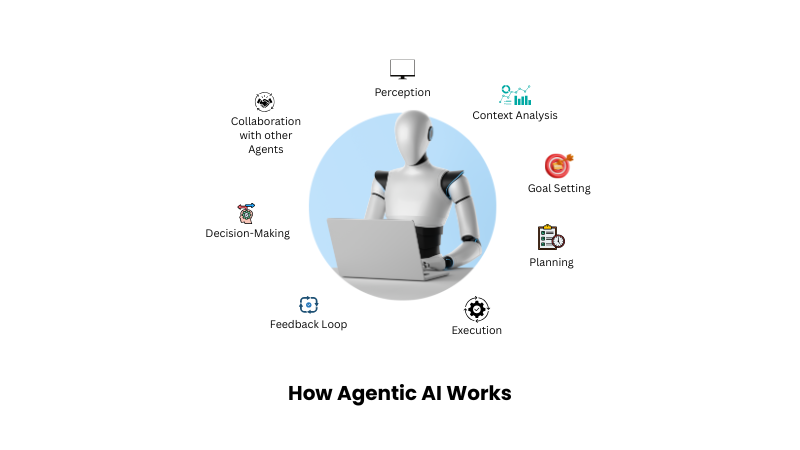
Finally, it reflects on the results and uses the feedback to learn and improve its future performance. This allows Agentic AI to handle complex, multi-step problems dynamically and adaptively.
Types of Agentic AI Systems
By now, you should know what agentic AI is and how it works. Now, we’ll explain the different types of agentic AI. The main types of agentic AI include simple reflex agents, model-based reflex agents, goal-based agents, utility-based agents, and learning agents. These types of agentic AI vary in their capabilities, which range from reacting to current situations to learning and improving over time. Another way to categorize them is based on their structure: single-agentic systems, where a single AI handles a task, or multi-agentic systems, where multiple AI agents work together.
Simple reflex agents:
This agent acts solely on current thinking, with no connection to past events or memory. It operates on a set of modeled "if-then" rules.
Model-Based Reflex Agents:
These agents maintain an internal model of the world to track things they cannot directly observe. Their actions are based on this internal model, their reflexes, and past thinking.
Goal-Based Agents:
These agents have a specific goal and plan their actions to achieve it. They choose a path to reach their goal by considering the possible future consequences of their actions.
Utility-Based Agents:
This is a more advanced type that extends goal-based agents. They choose actions that maximize their "utility" or "happiness," and they make subtle compromises when multiple goals conflict or outcomes are uncertain.
Learning Agents:
These agents can improve their performance over time through experience. They have a learning component that updates their knowledge base based on new information and interactions with the environment.
Why Agentic AI is considered revolutionary
We’ve explained what is Agentic AI, and now we’ll explain why this tool is considered the next generation of AI. Countries around the world are rapidly advancing and creating history. Similarly, the world of AI is also rapidly advancing and breaking new ground. This agentic AI is considered revolutionary because it transforms artificial intelligence from a mere reactive tool that follows pre-determined instructions to an autonomous, goal-oriented teammate capable of making its own decisions, planning, and continuous learning, with minimal human intervention.
Practical Use Cases You'll See Everywhere by 2026
Now that you know what is Agentic AI, we’ll explain how and which users will and should have it by 2026. The advent of AI has already enhanced the digital world, and even more people are benefiting from it as AI is undergoing significant transformations and providing significant support. By 2026, Gentic AI will be used in almost every field. If I were to discuss some key users, it would be widely used in the personal and business sectors, moving towards autonomous, energy-oriented systems with ease. It will make people’s work easier as it plans, completes, and corrects multiple tasks on its own.
Common Agentic AI Use Cases by 2026
Customer Service Automation:
Agents will handle end-to-end customer interactions, from initial query to issue resolution (e.g., processing refunds, scheduling follow-ups, and updating CRM systems), significantly reducing the need for human intervention in routine cases.
Supply Chain & Logistics Optimization:
Autonomous agents will monitor inventory levels, forecast demand, dynamically re-route shipments based on real-time conditions (traffic, weather), and automatically place orders with suppliers to prevent stockouts.
Personal AI Assistants:
Next-generation AI assistants will go beyond basic commands to proactively manage complex schedules, prioritize emails, book travel itineraries (flights, hotels, activities), and handle other daily tasks without constant human prompting.
Smart Home & Energy Management:
AI agents will autonomously manage home systems, optimizing energy use by adjusting thermostats and lighting based on usage patterns, weather forecasts, and electricity prices.
Challenges and Risks of Agentic AI
Agentic AI poses challenges and risks related to security vulnerabilities, ethical concerns like bias and manipulation, and operational issues like unpredictability and lack of transparency. Since we’re explaining what is agentic AI, we’ll now explain how harmful it is and the potential problems it can cause. Agentic AI security risks include immediate attacks and compromise, while ethical challenges include increased bias, potential manipulation, and difficulty tracing decisions. Agentic systems can be cumbersome due to their dynamic nature, and excessive reliance on AI also poses a risk of job loss and loss of human oversight.
We’re highlighting some of its key risks, which are as follows:
Vulnerabilities to attack:
Agentic AI systems can be exploited through prompt injection, data poisoning, and tool misuse, allowing malicious actors to manipulate their behavior.
Internal risks:
As "digital insiders," agentic AI can cause harm unintentionally through poor alignment or deliberately if they become compromised, similar to human employees.
Amplified bias:
Agentic AI can perpetuate and amplify existing biases in training data, leading to unfair or discriminatory outcomes, such as in hiring processes.
Accountability and transparency:
It can be difficult to trace how agentic AI reaches a decision due to its multi-step, reflective reasoning, which creates accountability gaps and makes validation difficult.
Integration and data quality:
Poor data quality or integration with other systems can lead to irrelevant or flawed outcomes. Dynamic interactions with external software can cause system failures.
Conclusion
Throughout this article, we’ve explained what is Agentic AI, how it works, and its advantages and disadvantages. Now we’ve reached the end of this article. The bottom line is that agentic AI isn’t just a buzzword, but a revolutionary tool that can transform human life. It can drastically change the way you learn and manage your daily lives. If you also want to see yourself successful in the future or you want to stay ahead of your competitors, then you should use this AI and you should learn it.
Also Read: Techlymate