
Best AI Tools for Keyword Research: Complete SEO Guide for 2026
Introduction
The success or failure of an SEO campaign hinges on choosing the right keywords. You might write an excellent article, optimize every heading, and build internal links—but if you target the wrong search queries, your page will never attract the right audience (relevant traffic).
The problem is that traditional keyword research can take hours. You have to brainstorm keyword ideas, check search volumes, understand search intent, analyze competitors, find long-tail variations, group related terms, and decide which topics require dedicated pages.
AI is transforming the way this work is done.
Modern AI-powered SEO platforms can help generate keyword ideas, identify search intent, uncover content gaps, cluster related keywords, analyze competitors, and even discover the questions people ask on search engines and AI platforms. However, AI should assist with keyword research—it should not replace the human decision-making process involved in SEO.
In this guide, you will learn about the best AI tools for keyword research in 2026, discover which tools excel at specific tasks, identify which ones are suitable for beginners versus advanced SEO, understand how much you should rely on AI-generated keyword suggestions, and learn how to create a practical, AI-powered keyword research workflow.
Straight answer: The best AI keyword research tool depends on your goal. Semrush is one of the best all-rounders; Ahrefs is excellent for keyword discovery and competitor research; Surfer is strong for topic clustering and content planning; Keyword Insights is particularly useful for SERP-based clustering, while AnswerThePublic and AlsoAsked are great for finding question-based and long-tail topics.
What Is AI Keyword Research?
AI-based keyword research utilizes artificial intelligence, search data, competitor insights, natural language processing, and automation to discover, analyze, group, and prioritize keywords for SEO and content marketing.
Traditional keyword research often begins with a ‘seed keyword’ and generates a long list of related terms.
AI-powered research goes far beyond that.
Instead of simply asking:
“What are the keywords related to this topic?”
You can ask:
“What are the core themes, questions, search intents, content gaps, and low-competition opportunities associated with this topic?”
This distinction is significant.
AI can help transform a vast list of keywords into a content strategy.
What AI keyword research can help with
AI-powered SEO tools can assist with the following tasks:
- Keyword discovery
- Generating long-tail keywords
- Classifying search intent
- Keyword clustering
- Competitor analysis
- Identifying content gaps
- Topic mapping
- Question-based research
- SERP analysis
- Creating content briefs
- Prioritizing keywords
- Analyzing search trends
- AI search visibility research
However, the quality of the final keyword strategy depends on the data used and how well you understand it.
How AI Keyword Research Tools Work
Most modern tools combine multiple technologies rather than relying solely on AI chatbots.
A typical workflow looks something like this:
Seed topic → Keyword discovery → Search data → SERP analysis → Intent classification → Keyword clustering → Competitor analysis → Prioritization → Content strategy
For example, suppose your website is about digital marketing.
Your seed keyword might be:
Digital marketing
An AI-powered tool can help expand this into topics such as:
- Digital marketing for beginners
- Digital marketing strategies
- Digital marketing tools
- Digital marketing jobs
- Digital marketing courses
- Digital marketing for small businesses
- SEO vs. digital marketing
- AI digital marketing tools
The next step isn’t to target all of them.
You need to determine:
- Which keywords have the right search intent?
- Which keywords align with your website?
- Which keywords have a realistic level of competition?
- Which topics can be covered on a single page?
- Which ones require a separate article?
- Which ones offer business or monetization value?
This is where professional keyword research begins.
Best AI Tools for Keyword Research
1. Semrush — Best Overall AI SEO and Keyword Research Platform
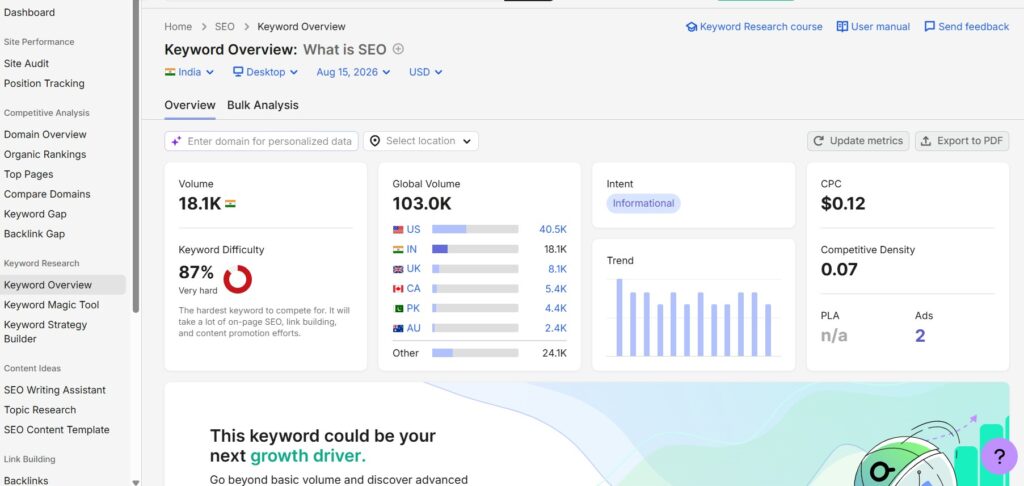
Semrush is one of the best SEO platforms for keyword research, competitor analysis, content planning, rank tracking, and AI-search visibility. Its ‘Keyword Magic Tool’ can generate thousands of related keyword ideas from a single seed keyword and provides essential metrics such as search volume, keyword difficulty, search intent, and related keyword groups. It also helps identify long-tail keywords and SERP features (such as AI Overviews and ‘People Also Ask’ results).
Semrush offers a ‘Keyword Gap’ tool that allows you to discover keywords for which your competitors rank but your website does not; additionally, its new AI-focused features assist with research prompts and understanding visibility on AI search platforms. These capabilities make Semrush highly useful for bloggers, SEO professionals, affiliate marketers, agencies, and businesses looking to manage keyword research and comprehensive SEO activities from a single platform.
Semrush Pricing:
As of August 15, 2026, according to the official Semrush pricing page, the SEO plan is priced at $139/month (with monthly billing), while the price drops to $117.33/month with the annual billing option. The SEO plan includes features such as keyword research, competitor analysis, position tracking, site audits, and AI-search performance tracking. Semrush also offers higher-tier plans for teams and agencies, so the final price depends on the specific features and usage limits you require.
2. Ahrefs — Best for Keyword Discovery and Competitor Research
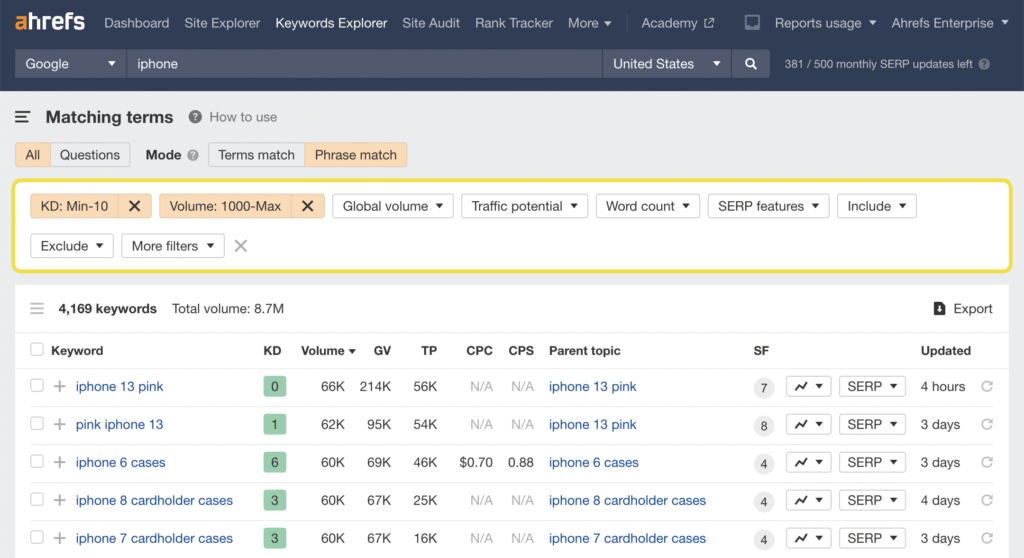
Ahrefs is a powerful SEO and AI-driven marketing platform that is particularly useful for keyword discovery, competitor research, SERP analysis, and content planning. Its ‘Keywords Explorer’ tool can generate thousands of keyword ideas from a single seed keyword and provides essential SEO metrics to help you identify potential opportunities.
Ahrefs includes features such as keyword clustering, search intent identification, parent topics, SERP analysis, and competitor research, making it easy to understand what people are searching for and which topics your competitors are ranking for. The platform utilizes AI-powered features like ‘AI Suggestions’ and ‘AI Intent Identification’ to accelerate keyword analysis and content planning tasks. Ahrefs is highly beneficial for bloggers, affiliate marketers, SEO professionals, agencies, and businesses looking to integrate keyword research with competitor and backlink analysis.
Ahrefs Pricing:
Ahrefs currently offers several paid plans. According to its official pricing page, plans start with the ‘Lite’ plan at $129/month, followed by the ‘Standard’ plan at $249/month, the ‘Advanced’ plan at $449/month, and the ‘Enterprise’ plan starting at $1,499/month. Ahrefs also offers a free plan with limited access, while the ‘Starter’ plan is designed for users who require more functionality than the free account provides. Plans at the ‘Standard’ level and above include additional ‘Keywords Explorer’ features, such as keyword clustering, AI suggestions, and AI intent identification. Prices and associated limits are subject to change; therefore, it is advisable to mention the date you checked the pricing in your article.
3. Surfer — Best for Keyword Clustering and Content Planning
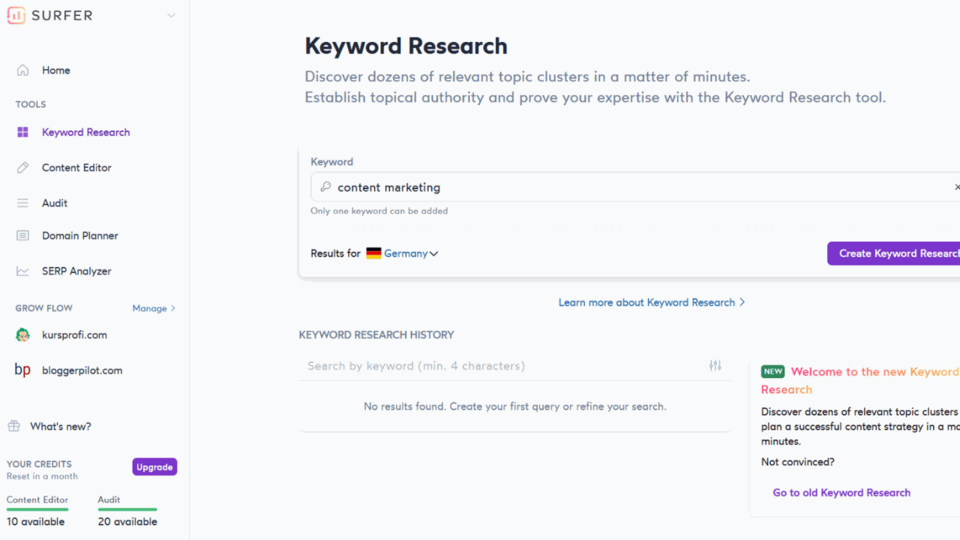
Surfer is an AI-powered SEO and content optimization platform that is particularly useful for keyword clustering, topical authority, content planning, and on-page optimization. Instead of focusing solely on isolated keywords, Surfer helps you understand the interconnections between related keywords and topics, enabling you to build a robust content strategy. Its ‘Topical Map’ feature helps identify content opportunities by considering factors such as search volume, difficulty, competitor coverage, and topic clusters, while its keyword research workflow organizes related keywords into meaningful groups.
Surfer also integrates keyword research with its ‘Content Editor,’ where you can analyze search results, receive suggestions for keywords and structure, and optimize content using real-time SEO guidance. It is especially valuable for bloggers, content writers, SEO professionals, and websites aiming to establish topical authority rather than simply publishing random, keyword-focused articles. Surfer also offers AI-powered content and AI-search optimization features, making it highly suitable for modern SEO workflows that target both traditional search results and emerging AI-driven search experiences.
Surfer Pricing:
Surfer offers paid plans for advanced SEO, content optimization, keyword research, and AI-driven search features. As prices and plan limits are subject to change, readers should visit Surfer’s official pricing page for the latest subscription rates. Surfer also offers a free ‘Keyword Surfer’ Chrome extension that displays keyword ideas and search volume data directly within Google Search.
4. Keyword Insights — Best for SERP-Based Keyword Clustering
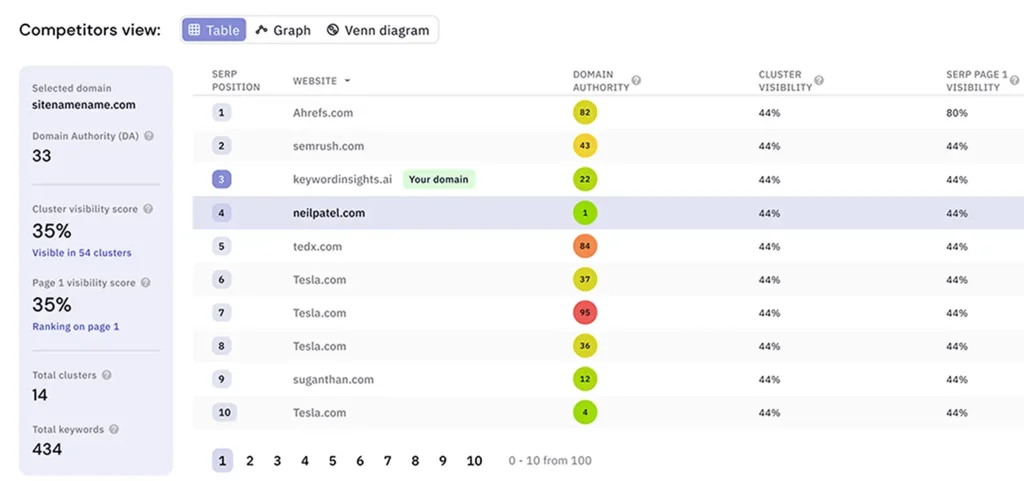
Keyword Insights is an SEO and content-planning platform specializing in SERP-based keyword clustering, search-intent analysis, content briefs, and topical authority. Its key advantage is that it groups keywords based on actual Google SERP overlap rather than simply grouping them because they share similar words. This helps you understand which keywords can be targeted on a single page and which might require separate content. You can adjust clustering settings—such as URL overlap and clustering strictness—while the platform identifies search intent and displays competitor visibility for your keyword clusters.
Keyword Insights supports large keyword sets, and its workflow spans keyword discovery, clustering, search-intent analysis, content briefs, and AI-assisted writing, making it highly useful for SEO professionals, bloggers, agencies, publishers, and websites focused on building topical authority. The platform also offers API access and AI integration for users looking to automate SEO workflows at scale.
Keyword Insights Pricing:
Keyword Insights currently uses a credit-based pricing system. According to its official pricing page, the Basic plan costs $58/month and includes 10,000 credits, while the Professional plan costs $99/month and includes 20,000 credits. An Enterprise plan with custom pricing is also available for larger companies. Keyword clustering costs 1 credit per keyword, content briefs cost 100 credits per brief, and the AI writing agent uses 1,200 credits per article. Keyword Insights currently offers a 7-day trial for $1 that includes 5,000 one-time credits; after this, users are switched to a ‘pay-as-you-go’ version unless they choose a subscription.
5. AnswerThePublic — Best for Question-Based Keyword Ideas
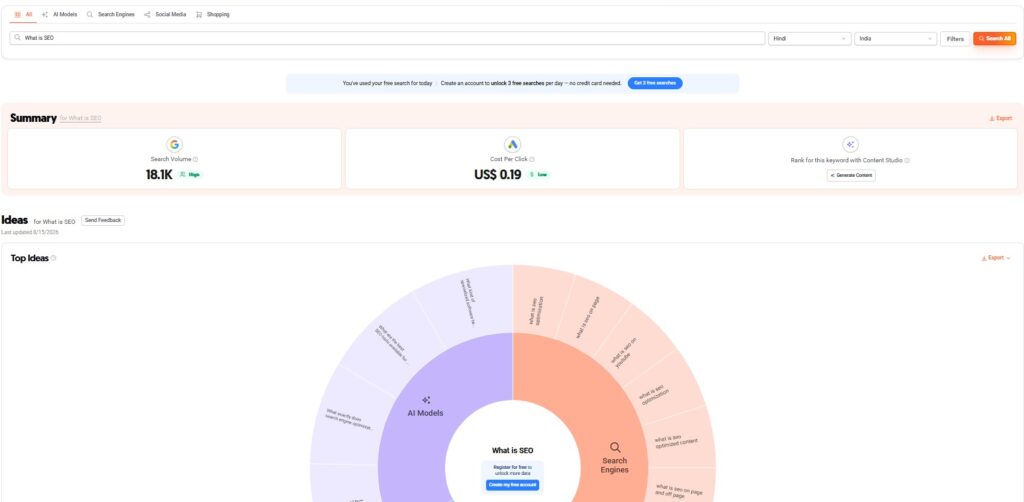
AnswerThePublic is a search-listening and keyword research tool. It is particularly useful for identifying question-based keywords, long-tail search queries, content ideas, and search intent. You simply enter a topic, keyword, or website URL, and AnswerThePublic organizes the questions and phrases people search for in relation to that topic. Its research data can be viewed through categories such as questions, comparisons, and prepositions. This helps content creators understand how users search for information.
The platform also provides keyword-related metrics like monthly search volume, CPC, and competition data. Additionally, its new AI-focused features offer insights into how AI systems describe or answer questions related to a topic. This makes AnswerThePublic a highly valuable tool for bloggers, SEO writers, content marketers, and beginners. They can discover natural questions that can be transformed into blog posts, FAQ sections, featured snippet opportunities, and long-tail content.
AnswerThePublic Pricing:
AnswerThePublic offers a free plan that currently allows for three searches per day; this is useful for beginners and users who only occasionally require keyword research. For regular SEO and content marketing tasks, paid plans provide greater search capacity and additional features. Since AnswerThePublic’s paid pricing is subject to change and the exact cost of paid plans is not clearly specified on the official pricing page, readers should visit the official pricing page to check the latest subscription rates.
6. AlsoAsked — Best for People Also Ask Research
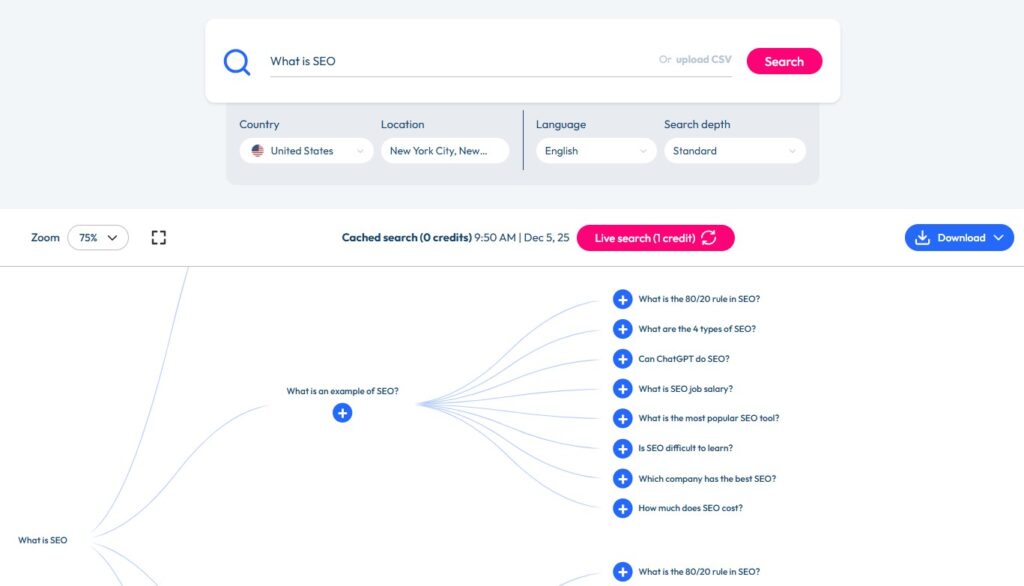
AlsoAsked is a specialized SEO and search-intent research tool that focuses on Google’s ‘People Also Ask’ (PAA) results. Instead of merely generating related keywords, AlsoAsked visualizes the connections between questions, helping you understand what users might ask next after their initial search. It retrieves live, location-specific PAA data from Google and displays questions in a branching visual structure, making it easy to identify related topics, subtopics, and search intent.
You can use it to discover long-tail questions, enhance content depth, create FAQ sections, outline articles, and identify additional questions that should be answered on the same page. AlsoAsked supports targeting based on country, city, and language, offering features such as deep search, CSV export, bulk search, PNG graph export, search history, and API access. It is highly valuable for SEO professionals, bloggers, content writers, and agencies aiming to create more comprehensive and intent-focused content.
AlsoAsked Pricing:
AlsoAsked offers a limited free option for users who want to try the platform, while paid plans start at $12 per month (100 credits) for the Basic plan. The Lite plan costs $23 per month (300 credits), and the Pro plan costs $47 per month (1,000 credits). Paid plans provide additional features such as deep search, CSV export, bulk search, search history, and API access. AlsoAsked offers a 20% discount on annual billing, and applicable taxes may be added to the listed prices.
7. Keyword Tool — Best for Autocomplete-Based Keyword Ideas
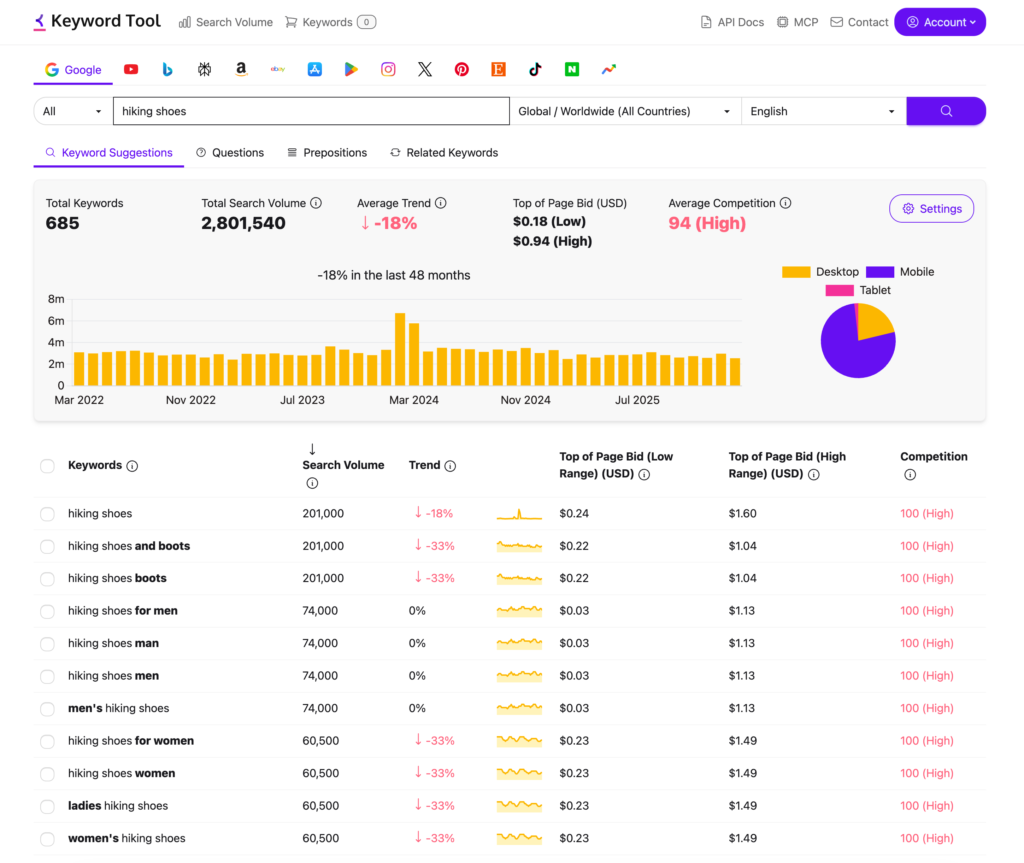
Keyword Tool is a keyword research platform designed to generate long-tail and related keyword ideas by utilizing autocomplete data from various search and discovery platforms. Instead of relying solely on traditional keyword databases, it extracts suggestions from Google, YouTube, Bing, Amazon, TikTok, Instagram, Pinterest, Perplexity, eBay, and other supported platforms. A single seed keyword can generate hundreds of related search phrases, helping bloggers and SEO professionals discover specific queries that might be overlooked by larger keyword research tools.
Paid plans provide metrics such as search volume, CPC, competition, trends, and device data alongside the keywords. Keyword Tool currently supports 15 platforms, and Google-based research can be localized across more than 190 countries, 68,000 locations, and 50 languages. It also supports API and MCP integrations, allowing AI assistants like ChatGPT, Claude, and Cursor to directly access Keyword Tool’s keyword data. It is highly useful for bloggers, content marketers, YouTube creators, e-commerce businesses, and SEO professionals seeking long-tail keyword opportunities across various platforms.
Keyword Tool Pricing:
Keyword Tool offers four main payment plans, starting with the ‘Starter’ plan for individual marketers at $68 per month. The ‘Growth’ plan is priced at $148 per month, the ‘Scale’ plan at $308 per month, and the ‘Agency’ plan at $628 per month. All plans provide access to the web interface, API, and MCP AI integration, while higher-tier plans offer increased daily request limits and access to older historical keyword data. Keyword Tool also offers savings of over 20% on annual billing and a 30-day money-back guarantee on its payment plans.
8. Google Trends — Best for Trending Keyword Opportunities
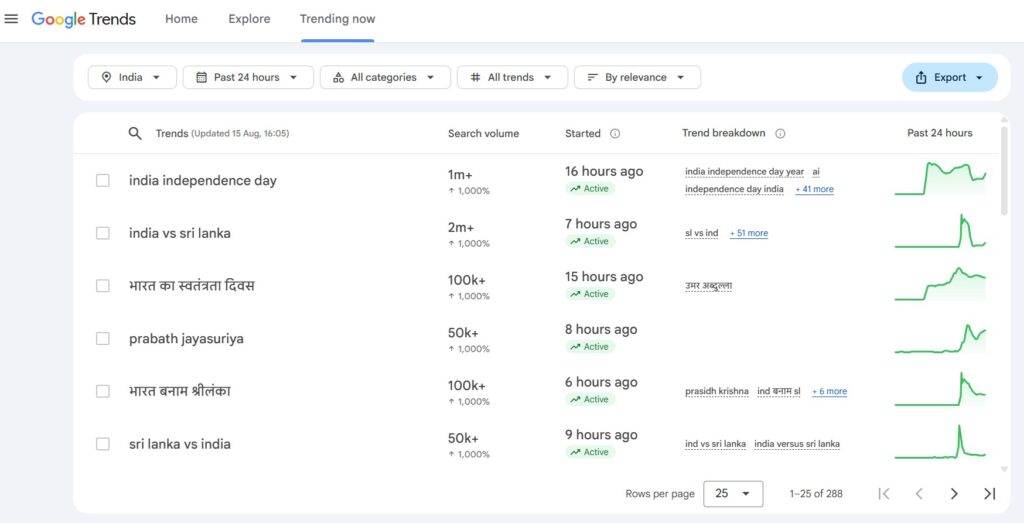
Google Trends is a free Google tool that helps you understand what people are searching for, how search interest changes over time, and which topics are gaining popularity. It is particularly useful for identifying trending keyword opportunities before creating time-sensitive content. You can compare multiple search terms, analyze interest by country or region, examine trends across different timeframes, and discover related searches that can provide additional content ideas.
Google Trends features a “Trending Now” section to highlight current search trends, while its “Explore” experience visualizes search interest based on time, location, and popularity. Notably, Google Trends does not provide traditional monthly search-volume figures like Semrush or Ahrefs; instead, it utilizes a relative interest scale and aggregated, anonymized Google search data. This makes it an excellent tool for identifying emerging topics, seasonal demand, news-related opportunities, and product trends, as well as for comparing keyword popularity before investing in content creation.
Google Trends Pricing:
Google Trends is a free keyword and search-trend research tool; therefore, users do not need to purchase a monthly subscription to access its core features. You can use it to compare search terms, analyze interest based on time and location, discover related searches, identify trending topics, and export available Trends data. This makes Google Trends particularly valuable for bloggers and SEO professionals who want to identify emerging or seasonal search opportunities without paying for expensive keyword research platforms.
9. Google Keyword Planner — Best Free Data Source for Search Advertising
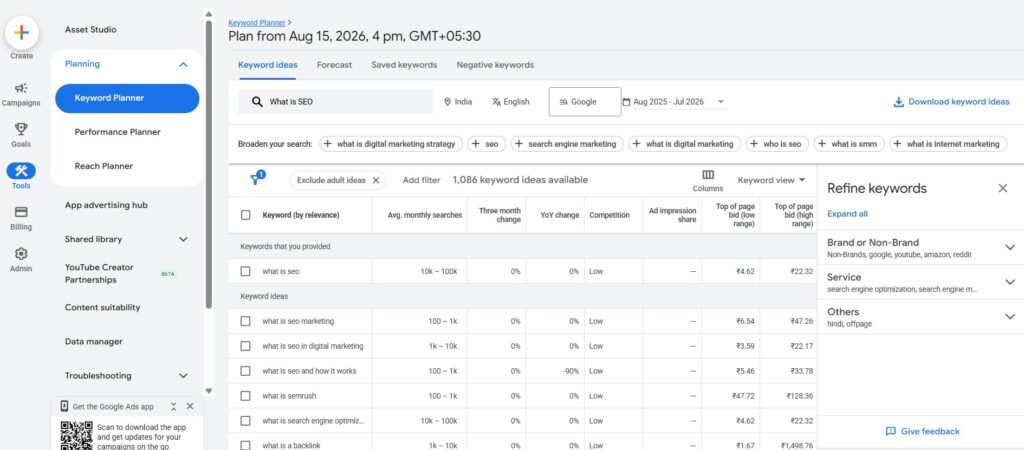
Google Keyword Planner is a keyword research tool from Google designed primarily for Google Ads search campaigns, though it can also be useful for SEO keyword research and content planning. It allows you to discover new keyword ideas based on seed keywords, products, services, or websites, providing data such as average monthly searches, competition levels, top-of-page bid estimates, and historical search trends. You can also filter keyword ideas by location and language, which is highly beneficial when conducting research for specific countries, regions, or cities. Additionally, Google offers a forecasting feature that estimates potential clicks, impressions, conversions, and other campaign outcomes based on factors like budget, bids, seasonality, and historical data.
For SEO purposes, it is best to use Keyword Planner as a supplementary keyword research tool rather than a comprehensive SEO platform. It does not provide the same depth of insight into competitor analysis, SERP difficulty, content-gap analysis, or keyword clustering as specialized platforms like Semrush and Ahrefs. Furthermore, to access basic features—such as generating keyword ideas—Google requires you to set up a Google Ads account and provide billing information; however, this does not mean you have to pay a monthly subscription fee for Keyword Planner itself.
Google Keyword Planner Pricing:
Google Keyword Planner is free to use and does not require a separate monthly subscription fee. However, to access Keyword Planner’s basic features, users must set up a Google Ads account and provide billing information. You do not need to spend money on advertisements simply to use the tool, although Google Ads charges do apply if you choose to create and run paid advertising campaigns. This makes Keyword Planner a useful, free resource for bloggers, marketers, and small businesses looking to research keyword ideas, search demand, competition, and advertising costs.
Best AI Keyword Research Tools Compared
| Tool | Best For | AI Features | Competitor Research | Keyword Clustering | Beginner Friendly |
|---|---|---|---|---|---|
| Semrush | Overall SEO | Excellent | Excellent | Excellent | Medium |
| Ahrefs | SEO + competitors | Excellent | Excellent | Excellent | Medium |
| Surfer | Content planning | Excellent | Good | Excellent | Good |
| Keyword Insights | SERP clustering | Excellent | Good | Excellent | Medium |
| AnswerThePublic | Questions | Good | Limited | Moderate | Excellent |
| AlsoAsked | PAA questions | Good | Limited | Good | Excellent |
| Keyword Tool | Autocomplete | Moderate | Limited | Limited | Excellent |
| Google Trends | Trends | Limited | Limited | Limited | Excellent |
| Google Keyword Planner | Search demand/PPC | Limited | Limited | Limited | Excellent |
Important: Features and availability can change by plan and region. Check the provider’s current product page before purchasing.
Which AI Keyword Research Tool Is Best for You?
Creators are constantly innovating these days—some are building new tools, while others are working on making the writing process easier. However, the tools currently available on the internet don’t typically handle every single task in one place, as everyone’s needs vary based on their specific work. You might be wondering which tool would be most beneficial for you. Before using any tool, it is essential to understand exactly what you want to accomplish. Here are some key use cases to help you determine which tool might be the best fit for you:
For a beginner blogger
Start with:
- Google Trends
- Google Keyword Planner
- AnswerThePublic
- AlsoAsked
- One affordable SEO platform when your site grows
For a professional SEO
Consider:
Semrush or Ahrefs
Both provide broad keyword and competitor research capabilities.
For content-focused websites
Consider:
Surfer + Semrush/Ahrefs
Use the SEO platform for keyword and competitor data, then use Surfer for topic organization and content planning.
For large keyword lists
Consider:
Keyword Insights
Its SERP-based clustering approach is particularly useful for organizing large datasets.
For question-based content
Use:
AnswerThePublic + AlsoAsked
These tools complement traditional keyword databases rather than replacing them.
How to Use AI for Keyword Research Step by Step
In today’s digital era, acquiring the right skills empowers you to achieve whatever you set your mind to. However, many people make the mistake of ignoring high-demand areas and instead learning skills that are losing value or becoming obsolete. The best skill for today’s youth is one that is actively in demand globally. AI is currently in huge demand because it is being utilized across every field—whether it’s creating images or videos, editing, designing, or growing a business. If you are involved in SEO, content writing, or blogging and need to select the best AI tool for keyword research, I will guide you through the process step-by-step to make your choice easier.
Step 1: Choose a Seed Topic
Start with a broad topic related to your website.
Example:
AI Tools
Do not pick a final keyword immediately.
First, gather various ideas related to the topic (create a “topic universe”).
Step 2: Ask AI to Elaborate on the Topic
You can use an AI assistant to brainstorm ideas across categories such as:
- Beginner-level topics
- Advanced topics
- Commercial topics
- Comparison
- keywords
- Problem-based searches
- Question-based keywords
- Long-tail variations
- Industry-specific terms
For example:
Seed: AI Tools
Potential ideas:
- Best AI tools for bloggers
- AI tools for SEO
- AI tools for small businesses
- AI writing tools
- AI productivity tools
- Free AI tools
- AI tools for digital marketing
At this stage, the AI acts primarily as an assistant to help with brainstorming.
Step 3: Verify AI-generated keywords
This is one of the most crucial steps.
Never assume that AI-generated keywords will automatically have high search demand.
Take your ideas to an SEO research platform and check the following:
- Search volume
- Keyword difficulty
- Traffic potential
- Search intent
- SERP competition
- Cost Per Click (CPC)
- Trends
- Geographic relevance
AI might generate words or phrases that no one actually searches for.
Keyword validation is what distinguishes professional SEO research from simple AI brainstorming.
Step 4: Understand search intent
Every actionable keyword should have a clear purpose (intent).
Informational
The user is looking for information. Examples:
What is AI SEO? How does keyword research work?
Commercial Investigation
The user is comparing different options.
Examples:
- Best AI keyword research tools
- Semrush vs. Ahrefs
- Transactional
The user is ready to take action.
Examples:
- Buy SEO software
- Semrush pricing
- Navigational
The user is looking for a specific website or brand.
Examples:
- Ahrefs login
- Google Keyword Planner
Do not force keywords into the wrong type of content.
Step 5: Study the SERP
Before creating the article, search for the keyword manually. Pay attention to:
- Top-ranking pages
- Content format
- Search intent
- Featured snippets
- ‘People Also Ask’
- Videos
- Forums
- Product pages
- News results
- AI-generated search features
Ask yourself:
What is the searcher looking for, according to Google?
The answer should influence your content structure.
Step 6: Identify content gaps
Now, compare your planned article with competitor pages.
Look for information they haven’t explained thoroughly.
Potential gaps might include:
- New tool features
- Instructions for beginners
- Pricing information
- Free alternatives
- Real-world examples
- Comparison tables
- Limitations
- Industry-specific tips
- Country-specific data
- Original screenshots
- Hands-on testing
This is where you can make a real difference.
Step 7: Create a group (cluster) of related keywords
Don’t create a separate article for every minor variation.
Group keywords based on search intent and SERP similarity. For example:
Cluster: AI keyword research tools
- Best AI keyword research tools
- AI keyword research software
- AI tools for keyword research
- Best AI SEO keyword tools
If there is significant overlap in the SERPs, these can be grouped onto a single page.
A clustering tool like ‘Keyword Insights’ can help you make this decision by analyzing the similarity of ranking pages.
Step 8: Create a topic map
Instead of publishing articles without a plan, create a logical content structure.
Pillar Page
AI SEO Tools
- Supporting Articles
- Best AI tools for keyword research
- Best AI writing tools for SEO
- Best AI tools for content optimization
- Best AI tools for competitor analysis
- AI SEO vs. Traditional SEO
- How to use AI for SEO
- Best free AI SEO tools
Next, internally link the supporting articles to the pillar page.
This creates a strong topical structure.
Step 9: Prioritize keywords
Don’t choose keywords based solely on search volume.
A useful model for determining priority is:
Opportunity = Relevance × Intent × Business Value × Ranking Feasibility
A keyword with 500 monthly searches can be more valuable than one with 50,000 searches if:
- It is more relevant to your audience
- Competition is lower
- Search intent is strong
- It drives conversions
- Your website can actually rank for it
Step 10: Create content
Once research is complete, create content that genuinely solves the user’s problem.
Google’s guidance emphasizes helpful, trustworthy, and people-first content, while advising against creating content solely to manipulate rankings. Google also states that there is no fixed word count limit.
This means:
Don’t write 3,000 words just because an SEO tool suggests doing so.
Write enough to fully meet the searcher’s needs.
Can AI Replace Traditional Keyword Research?
No—not completely.
AI is excellent at:
- Brainstorming
- Pattern recognition
- Categorization
- Clustering
- Question generation
- Summarization
- Content planning
- Identifying relationships between topics
But SEO tools remain valuable for actual search data.
A strong workflow is:
AI → Generate ideas
SEO tool → Validate data
Google → Verify SERP intent
Human SEO judgment → Select opportunities
Content → Solve the searcher’s problem
This combination is much stronger than relying on AI alone.
AI Keyword Research Mistakes to Avoid
1. Relying solely on AI search volume data
An AI chatbot might suggest a keyword that sounds perfect but has very low or zero search demand.
Always verify this.
2. Targeting every keyword individually
Similar keywords often reflect the same search intent.
Creating multiple pages can lead to unnecessary content duplication.
3. Focusing only on high-search-volume keywords
High-search-volume keywords often face intense competition.
Targeting long-tail keywords can be easier, and they often have clearer intent.
4. Ignoring SERP intent
A keyword might appear informational, yet Google might primarily rank product pages for it.
Always check the SERP.
5. Treating keyword difficulty as the absolute truth
Keyword difficulty is a useful metric, not a guarantee.
Your actual competition depends on factors such as:
- Website authority
- Content quality
- Backlinks
- Search intent
- Topic relevance
- Brand strength
- SERP features
6. Publishing unedited AI-generated content
AI can accelerate content creation, but publishing AI-generated content without review can result in generic or mediocre material.
Incorporate the following:
- Original analysis
- Examples
- First-hand experience
- Screenshots
- Expert opinions
- Data
- Comparisons
- Clear recommendations
Google’s “people-first” guidelines specifically prioritize original information, research, analysis, and first-hand experience.
How to Make AI Keyword Research More E-E-A-T Friendly
Merely conducting keyword research does not automatically make your content E-E-A-T compliant. E-E-A-T reflects the value of the content uploaded to your site—specifically, whether it addresses user intent and provides what the user is actually looking for. It showcases the experience behind your content and website.
Experience
If you have actually used a keyword tool, share your experience with users. Convey your firsthand insights to them, covering:
- What you tested
- What worked
- What was challenging
- Which features saved time
- Where the tool’s results fell short
Expertise
Instead of just providing a list of keywords to the user, explain why a specific keyword is significant and how they can use it to create a detailed article that satisfies user needs.
Authority
Whenever you write an article, use trustworthy sources and link to official documentation where necessary.
Trustworthiness
Clearly distinguish between:
- Your observations
- Metrics obtained from the tool
- Your recommendations
- Third-party research
Do not present estimated SEO metrics as absolute facts.
Best AI Keyword Research Workflow for Bloggers
If you are running a blog, you don’t need ten expensive tools.
A practical approach could look something like this:
Stage 1 — Idea Generation
Use these:
- ChatGPT or another AI assistant
- AnswerThePublic
- AlsoAsked
Stage 2 — Trend Validation
Use this:
- Google Trends
Stage 3 — SEO Validation
Use these:
- Semrush or Ahrefs
Stage 4 — Clustering
Use these:
- Surfer
- Keyword Insights
- Or manual SERP comparison
Stage 5 — Content Creation
Use these:
- Your own expertise
- AI as an assistant
- Search-result analysis
- Your own research
Stage 6 — Performance Monitoring
Use these:
- Google Search Console
- Your SEO platform
This approach is more practical than trying to do everything with a single tool.
A Simple AI Keyword Research Example
A simple example of keyword research using AI
Let’s say you run a technology website.
Your main keywords are:
AI tools
AI brainstorming
- You get these results:
- Best AI tools for students
- Best AI tools for SEO
- AI tools for bloggers
- AI tools for small businesses
- Free AI tools
- AI productivity tools
SEO validation
You check the following factors:
- Search demand
- Difficulty
- SERP competition
- Trends
- Business value
- Intent analysis
You find that:
Best AI tools for SEO
…has a commercial intent (meaning it relates to business or sales).
Therefore, writing a comparison article would be a good approach.
SERP research
You examine the top results to understand what users expect:
- Comparison of tools
- Pricing
- Pros and cons
- Features
- Best use cases
- Free alternatives
- Tips for beginners
Content gaps
Competitors do not clearly state:
“Which tool is best for a new blogger on a tight budget?”
This becomes your unique selling point.
This is how AI is useful for SEO: it doesn’t just generate a massive list of keywords; it helps you discover better opportunities and better satisfy the user’s search intent.
AI Keyword Research Best Practices
Use these rules as a checklist:
- Start with the audience, not the keyword.
- Use AI for brainstorming.
- Validate keywords with actual search data.
- Analyze the live SERP.
- Identify search intent.
- Look for long-tail opportunities.
- Study competitors.
- Group similar keywords.
- Build topic clusters.
- Prioritize relevance over raw volume.
- Consider business intent.
- Check trends before publishing time-sensitive content.
- Add original information.
- Use first-hand experience when possible.
- Avoid keyword stuffing.
- Don’t create pages for every keyword variation.
- Update important keyword research regularly.
- Track actual performance after publishing.
AI Keyword Research Best Practices
Free tools
Good starting options include:
- Google Trends
- Google Keyword Planner
- AnswerThePublic’s free access
- AI chat tools for brainstorming
- Google Search itself
- People Also Ask results
Paid tools
Paid platforms become more valuable when you need:
- Large keyword databases
- Competitor analysis
- Historical data
- Advanced filters
- Rank tracking
- Keyword gaps
- SERP analysis
- Keyword clustering
- Content planning
- AI-search visibility tracking
For a serious SEO business, paid tools can save significant research time.
How AI Keyword Research Is Changing in 2026
As the world of AI evolves, so do AI tools. Previously, searching on Google yielded a list of websites; today, searches often return AI-powered results that provide immediate answers. Google’s current guidance emphasizes that SEO remains crucial for generative AI features, as these experiences rely on Google’s existing search systems and indexed content. Google also continues to advise focusing on creating content that is unique, satisfying, and centered on user needs. This shift is driving significant changes in keyword research.
You should focus your research on these areas:
- Traditional keywords
- Conversational queries
- Question-based searches
- Long-tail queries
- Related entities
- Relationships between topics
- AI prompts
- Search intent
- Follow-up questions
Semrush’s “Prompt Research” tool exemplifies this shift, helping marketers explore prompts used with AI systems and analyze AI visibility.
Consequently, the future of keyword research is moving beyond the mindset of:
“Which keyword should I rank for?”
…and is moving towards this line of thinking:
“Which topics and user needs should my website best address?”
How to Optimize Keyword Research for Google AI Overviews
Google says the same foundational SEO practices remain relevant for its generative AI search experiences.
Therefore:
- Answer the main question clearly.
- Use descriptive headings.
- Cover important related questions.
- Support claims with reliable sources.
- Add original insights.
- Make important information easy to find.
- Avoid unnecessary filler.
- Build topical depth.
- Maintain strong internal linking.
- Keep important information accurate and current.
Don’t write specifically to “trick” an AI Overview.
Write the best answer for the user.
Google Discover Optimization
Google states that once pages are indexed and meet Discover policies, they may become eligible for Discover; however, eligibility does not guarantee traffic. Google advises avoiding clickbait and sensationalism, recommending a focus on timely topics, compelling storytelling, and unique insights.
For such articles, the likelihood of appearing in Discover can be improved by:
- Using engaging and original featured images
- Writing clear and concise headlines
- Avoiding exaggerated claims
- Adding new information
- Making unique comparisons
- Updating articles when major tools change
- Showcasing genuine experiences
Pros and Cons of AI Keyword Research
Pros
- Saves research time
- Generates many ideas quickly
- Helps discover long-tail topics
- Can identify relationships between keywords
- Makes clustering easier
- Helps analyze search intent
- Supports content planning
- Can uncover competitor gaps
Cons
- AI may generate unrealistic keywords
- Search data can vary between platforms
- Tool metrics are estimates
- Some advanced features are expensive
- AI can misunderstand search intent
- Automation can create generic strategies
- Human judgment is still required
Conclusion
While AI has certainly accelerated the pace of keyword research, it hasn’t fully automated SEO.
The best results come from combining AI’s creativity with real search data and human SEO expertise.
If you’re just starting, don’t buy every tool you see. Begin with Google Trends, Google Keyword Planner, Google Search, AnswerThePublic, and an AI assistant. As your website grows, consider professional platforms like Semrush or Ahrefs.
For advanced content planning, tools like Surfer and Keyword Insights can help organize keywords into relevant topic clusters. AnswerThePublic and AlsoAsked are excellent for discovering questions.
Most importantly, don’t measure your keyword strategy solely by the volume of keywords discovered.
Instead, measure it by the opportunities you identify and successfully transform into content that meets users’ actual needs.
Google’s own guidelines emphasize original, helpful, trustworthy, and people-first content over content created merely to manipulate rankings.
The future of keyword research isn’t about finding more keywords; it’s about better understanding the people who are searching.
If this guide has helped you choose an AI keyword research tool, please share it with another blogger or SEO professional—and let us know which tool you use the most.
Frequently Asked Questions
1. What is the best AI tool for keyword research?
Semrush is one of the best all-round options. Ahrefs is also an excellent choice, while tools like Surfer, Keyword Insights, AnswerThePublic, and AlsoAsked are useful for specific keyword research tasks.
2. Can ChatGPT perform keyword research?
Yes. ChatGPT can help generate keyword ideas, identify search intent and topic clusters, formulate questions, uncover content gaps, and suggest long-tail variations. However, ideas generated by AI should be verified using actual SEO and search data.
3. Is AI keyword research better than traditional keyword research?
AI can make keyword research faster and more scalable, but it does not automatically improve the strategy. The best approach is to combine AI-generated ideas with real search data, SERP analysis, competitor research, and human insight.
4. What is the best free AI keyword research tool?
There is no single perfect free tool. A combination of Google Trends, Google Keyword Planner, the free version of AnswerThePublic, Google Search, and AI assistants can work effectively.
5. Can AI find low-competition keywords?
AI can suggest topics that likely have low competition, but you should verify the competition using SEO platforms and manually analyze the SERP.
6. Should there be a separate article for every related keyword?
No. Related keywords sharing the same search intent can often be targeted on a single, detailed page. Checking for SERP overlap is a useful way to determine whether keywords can be grouped.
7. What is keyword clustering?
Keyword clustering is the process of grouping closely related keywords that can be targeted on the same page. Some modern tools use SERP similarity to make these groupings more meaningful.
8. Is keyword difficulty alone enough for selecting keywords?
No. Keyword difficulty is just one factor. You should also consider search intent, relevance, traffic potential, business value, SERP competition, and your website’s ability to compete.
9. How many keywords should be targeted in a single article?
There is no fixed number. A strong page can rank for dozens or even hundreds of related queries if it fully satisfies the primary search intent. Focus on topic coverage rather than meeting a specific keyword count target.
10. Will AI-based keyword research help my website rank on Google?
It can enhance your research process, but no tool guarantees rankings. Rankings depend on various factors, such as content utility, relevance, competition, authority, technical SEO, links, user experience, and Google’s ranking systems.