
AI Smart Glasses in 2026: The Complete Guide to Features, Best Options, Pricing & the Future of Wearable AI
Introduction
Your phone is no longer the only device capable of seeing, hearing, understanding, and reacting to the world around you. By 2026, AI smart glasses are evolving from mere novelties into a serious new computing platform.
The challenge lies in the rapidly complicating smart-glass market. Some models are essentially Bluetooth headphones with cameras, while others feature powerful AI assistants. New products provide displays, navigation, translation, and context-aware information right within your field of view.
And then there is the big question: Is buying AI smart glasses 2026 actually worth it, or are they still just an expensive experiment?
The answer depends largely on what you expect from them.
This guide explains how AI smart glasses work, what they can actually do in 2026, which products are worth buying, their pricing, drawbacks, and privacy concerns, as well as what the next generation of wearable AI might look like.
What are AI smart glasses?
AI smart glasses are wearable glasses that combine standard eyewear with technologies such as cameras, microphones, speakers, wireless connectivity, sensors, and artificial intelligence.
Unlike traditional smart glasses, new AI glasses can understand voice commands and, in some cases, even comprehend what the wearer is looking at.
For example, you could ask:
“Which building am I looking at?”
These glasses can capture information using their cameras, send it to an AI system, and provide answers through built-in speakers.
Depending on the model, AI smart glasses can also perform tasks such as:
- Taking photos
- Recording videos
- Answering questions
- Making phone calls
- Sending messages
- Playing music
- Translating languages
- Describing objects
- Identifying landmarks
- Providing directions
- Summarizing information
- Remembering specific details
- Connecting to smartphone apps
- Assisting with accessibility
A key difference is that not all smart glasses feature a display.
Some rely primarily on audio and cameras, whereas newer AR/XR glasses can project digital information directly into your field of view.
Why is 2026 a significant year for smart glasses?
Data indicates that smart glasses are no longer products intended solely for a niche market.
According to an IDC report, shipments of smart glasses without displays saw a 167% year-over-year increase in the first quarter (Q1) of 2026, reaching approximately 2.25 million units in that quarter alone. IDC projects that total shipments of smart glasses without displays will reach approximately 13.6 million units for the full year of 2026. Counterpoint Research has reported even faster growth, noting a 212% year-over-year increase in the global smart-glass market during the first half (H1) of 2026. According to Counterpoint, Meta accounted for approximately 84% of global shipments during that period.
This highlights a key insight:
AI is becoming a primary driver for purchasing smart glasses.
The first wave of smart glasses focused mainly on features like:
- Cameras
- Music
- Calls
- Notifications
- Social sharing
The new generation adds another crucial element:
Contextual AI.
Instead of simply recording what you see, these glasses can actually understand it.
How AI Smart Glasses Work
AI glasses combine multiple technologies into a single wearable device.
1. Camera
The camera captures images and video.
This allows the AI system to understand visual information, such as:
- Signs
- Buildings
- Food
- Products
- Documents
- Objects
- People
- Landscapes
2. Microphone
Multiple microphones capture your voice and help reduce background and wind noise.
This enables hands-free conversation.
3. Speaker
Most AI glasses without a display feature open-ear speakers.
Instead of inserting earbuds into your ears, the speakers direct sound toward your ears.
4. AI Assistant
This is the most crucial component.
Depending on the product, the AI can run on systems such as:
- Meta AI
- Gemini
- Other cloud AI models
- On-device AI systems
5. Smartphone Connection
Many modern AI glasses rely heavily on smartphones.
The phone can provide:
- Internet access
- GPS
- Processing power
- Apps
- Account authentication
- Cloud connectivity
6. Sensors and Connectivity
Modern smart glasses may include:
- Bluetooth
- Wi-Fi
- Touch controls
- Accelerometers
- Cameras
- GPS via a connected phone
- Environmental sensors
For example, Qualcomm’s Snapdragon AR1 Gen 1 platform was designed specifically for smart glasses and supports camera processing, AI, connectivity, and binocular displays.
What can AI smart glasses do in 2026?
This is where the category gets interesting.
1. Ask questions about what you see
Imagine you are walking through a historic city. Instead of pulling out your phone to search:
“What building is this?” You can simply ask your glasses.
Meta’s Ray-Ban Meta products already support visual AI interactions, such as asking about landmarks and translating text.
2. Language translation
Language translation is one of the most useful functions.
AI glasses can help translate:
- Restaurant menus
- Street signs
- Conversations
- Written instructions
- Tourist information
For travelers, this might be the biggest reason to own AI glasses.
3. Taking photos and videos
Modern AI glasses can capture content without you having to hold a smartphone. For example, the Ray-Ban Meta Gen 2 features a 12MP ultra-wide camera and 3K video recording capabilities. This is particularly useful when you are:
- Hiking
- Cycling
- Traveling
- At an event
- Creating POV videos
- Recording spontaneous moments
4. Making calls and sending messages
AI glasses can also function as hands-free communication devices.
You can do all of the following:
- Call contacts
- Reply to messages
- Listen to messages
- Control music
- Use supported apps
This is extremely useful when your hands are occupied with other tasks.
5. Navigation
Navigation is another area where smart glasses can bring significant improvements.
Google’s Android XR vision includes glasses that understand where the wearer is standing and the direction they are facing, enabling spoken turn-by-turn guidance.
In the future, glasses with displays could make navigation even simpler and more intuitive by showing arrows directly within your field of view.
6. AI-Powered Memory
Another emerging concept is AI-assisted recall. Instead of having to remember:
“Where did I park the car?”
Your glasses can help you recall that information later.
Meta has also announced features like ‘recall’ and context-aware capabilities for its AI glasses.
However, memory-related features also raise significant privacy concerns, which we will discuss later.
Best AI Smart Glasses in 2026
Here is a simplified comparison of the major platforms worth watching.
| Product | AI | Camera | Display | Best For |
|---|---|---|---|---|
| Ray-Ban Meta Gen 2 | Meta AI | 12MP | No | Everyday use |
| Oakley Meta HSTN | Meta AI | 12MP | No | Outdoor/performance |
| Oakley Meta Vanguard | Meta AI | Yes | No | Sports |
| Google Android XR glasses | Gemini | Varies | Audio/display models | AI + Android ecosystem |
| XREAL / display-focused glasses | Varies | Model dependent | Yes | Large virtual displays |
| Other AI-first glasses | Varies | Varies | Usually no | Specific AI use cases |
The market is evolving quickly, so specifications and availability should be checked before purchase.
Ray-Ban Meta Gen 2
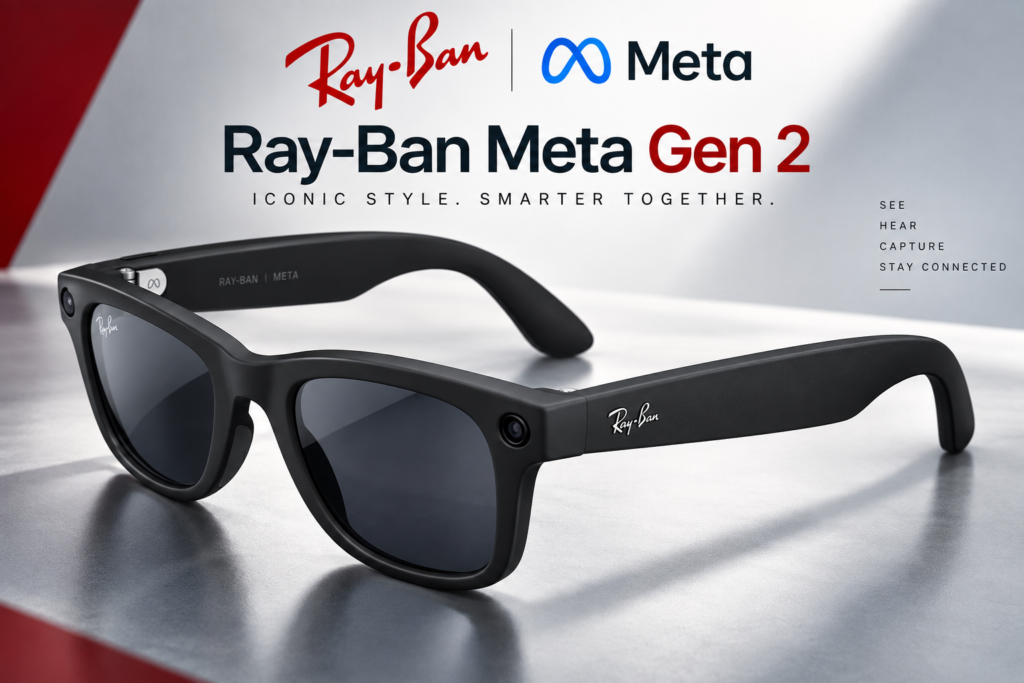
For many customers, the Ray-Ban Meta Gen 2 is currently the best mainstream AI-glasses option.
Meta launched this second-generation model in India in December 2025, with a starting price of ₹39,900.
Key features of the Indian model:
- 12MP ultra-wide camera
- 3K Ultra HD video
- Up to 8 hours of battery life
- Charging case
- Open-ear audio
- Meta AI
- Voice control
- Hindi language interaction
- Translation
- Photo and video capture
- Prescription options
- Smartphone connectivity
Specifications for the Indian Gen 2 model also include Wi-Fi 6E, Bluetooth 5.3, 32GB storage, and IPX4 water resistance.
Why it stands out
Its biggest advantage doesn’t come from just one specific feature.
It is a combination of all these elements:
Glasses that look ordinary + Camera + Audio + AI + An already famous eyewear design.
This makes them comfortable to wear all day long.
Best for:
- Travelers
- Content creators
- Casual users
- Social media creators
- People who already wear glasses
- Hands-free interaction
Oakley Meta
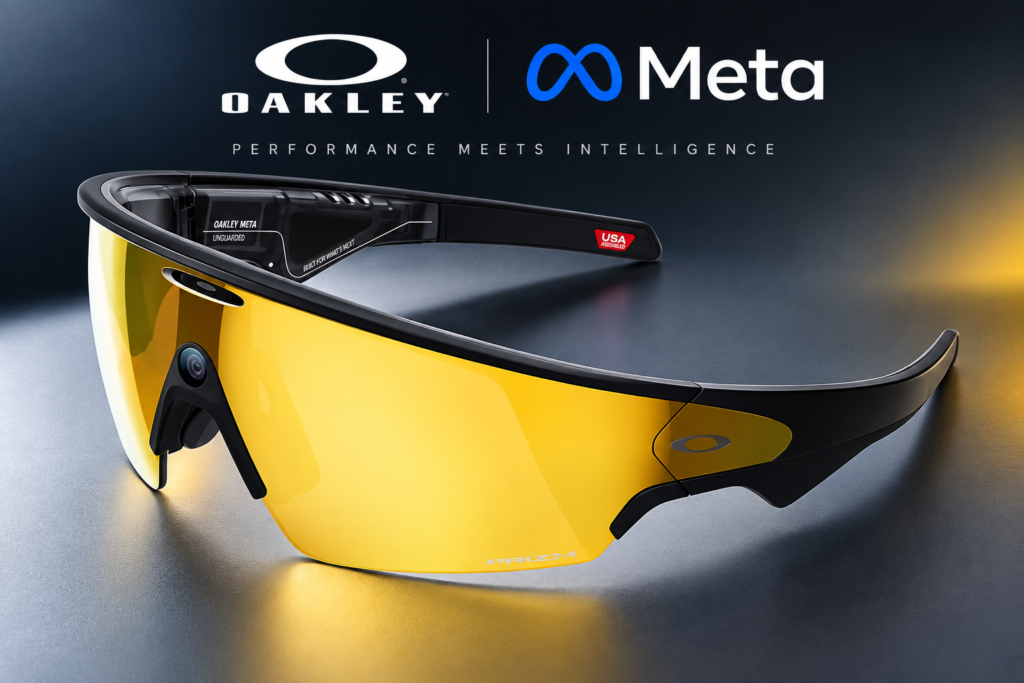
While the Ray-Ban Meta is designed for everyday life, the Oakley Meta focuses more on performance and outdoor activities.
The Oakley Meta HSTN features:
- Meta AI
- Camera
- Open-ear audio
- Performance-oriented design
- Water resistance
- Hands-free recording
Meta has also emphasized AI applications, such as surfing condition updates and golf-related analysis.
Best for:
- Runners
- Cyclists
- Golfers
- Outdoor enthusiasts
- Athletes
- Adventure travelers
Google Android XR Smart Glasses
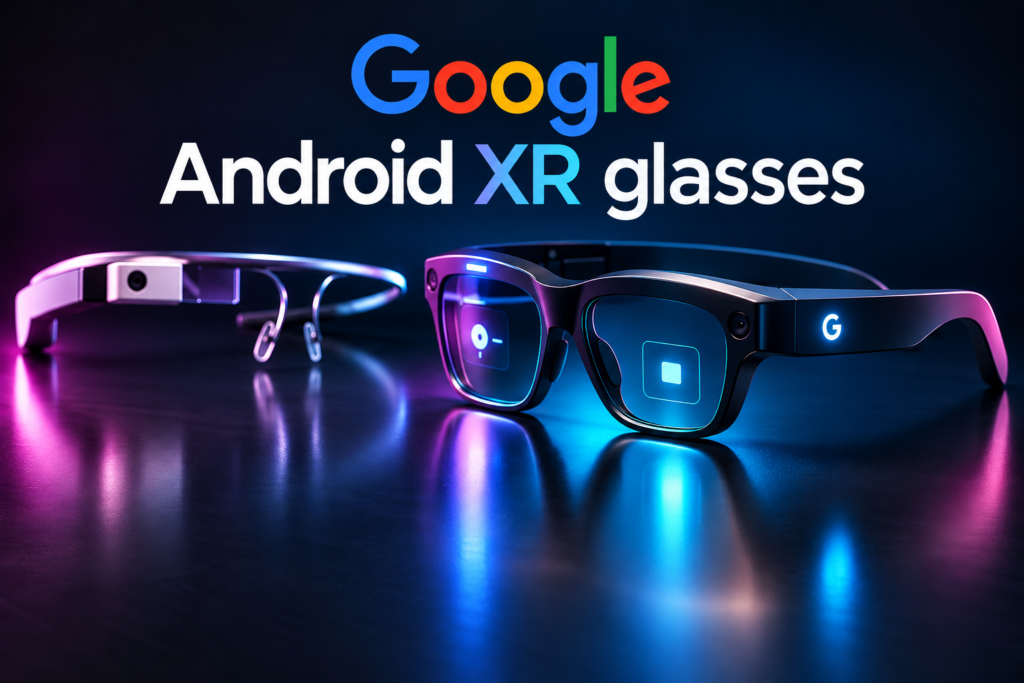
Google is taking a different approach. Instead of creating just one type of eyewear based on a single product family, Google is collaborating with Samsung and eyewear partners to build an Android XR ecosystem.
At Google I/O 2026, Google announced two categories:
Audio glasses
These provide AI assistance via voice through built-in speakers.
Display glasses
These can display information directly in the wearer’s field of view. Google has announced partnerships with eyewear brands like Gentle Monster and Warby Parker, with plans to launch audio glasses in the fall of 2026.
Gemini is expected to support the following capabilities:
- Visual queries
- Navigation
- Calls
- Messaging
- Translation
- Photography
- App interaction
- Multi-step tasks
Google also states that these glasses will work with both Android and iOS phones.
Why this matters
Google’s approach could make AI glasses more effective as an extension of the Android ecosystem, rather than just cameras equipped with speakers.
AI Smart Glasses vs AR Glasses
These terms are often confused.
| Feature | AI Smart Glasses | AR Glasses |
|---|---|---|
| Camera | Usually | Usually |
| AI assistant | Core feature | Often |
| Speakers | Common | Common |
| Display | Sometimes absent | Usually present |
| Virtual objects | Limited | Core capability |
| Navigation | Audio-based or display | Visual + spatial |
| Weight | Usually lighter | Usually heavier |
| Battery demand | Lower | Higher |
| Everyday eyewear | Easier | More difficult |
| Main purpose | AI assistance | Digital augmentation |
Simple explanation
AI smart glasses help you interact with AI.
AR glasses add digital information to what you see.
The two categories are gradually merging.
AI Smart Glasses for Travelers
Using them while traveling can be a fantastic experience.
Imagine arriving in Tokyo, Paris, Dubai, or New York.
Instead of constantly pulling out your phone, AI glasses can help you:
- Translate signboards
- Understand menus
- Identify landmarks
- Find your way
- Take POV (point-of-view) photos
- Record short videos
- Make calls
- Ask questions
- Discover nearby places
Google has showcased specific features for its Android XR eyewear concept, such as visual Q&A, translation, navigation, and finding nearby restaurants.
A Travel Scenario
You are exploring an unfamiliar city and spot a historic building.
Instead of stopping to do all this:
- Taking out your phone
- Opening the camera
- Searching for information about the building
- Reading the results
You can simply ask:
“Hey, what building is this?”
The AI can understand what you are looking at and provide an answer directly through the glasses.
This eliminates several steps.
AI Smart Glasses for Content Creators
Creators have another compelling reason to consider AI glasses.
Traditional smartphone filming requires you to:
- Hold your phone
- Frame the shot
- Start recording
- Look at the screen
- Stop recording
- Edit the footage
Smart glasses can offer a more natural ‘first-person perspective’ (seeing the scene through your own eyes).
Useful Applications
- Travel reels
- Walking tours
- Cycling videos
- Food content
- Behind-the-scenes footage
- POV storytelling
- Event coverage
- Street photography
However, this footage won’t automatically replace professional cameras. For cinematic production, mirrorless cameras or high-end smartphones still offer superior control over:
- Lenses
- Dynamic range
- Stabilization
- Depth of field
- Audio
- Color grading
It is best to view smart glasses as a new camera angle rather than a complete replacement for traditional cameras.
AI Smart Glasses for Accessibility
Accessibility could be one of the most significant use cases for AI glasses.
An AI-integrated camera can describe surroundings, identify objects, read text, and provide hands-free assistance.
Meta has particularly emphasized their utility for users who are blind or visually impaired, as well as for those with mobility issues. Potential applications include:
- Reading signboards
- Describing surroundings
- Identifying objects
- Translating text
- Hands-free interaction
- Navigation assistance
However, users should view the details provided by AI as helpful information rather than absolute fact.
In critical safety situations, human judgment and existing accessibility tools remain essential.
Privacy and Security
This is the biggest issue associated with AI smart glasses.
A smartphone camera is clearly visible.
A camera embedded in ordinary-looking glasses is not easily noticeable. This raises several valid concerns, such as:
- Recording people without consent
- Sensitive locations
- Workplace privacy
- Schools
- Hospitals
- Private conversations
- Facial recognition
- AI analysis of the surrounding environment
- Data storage
- Cloud processing
Recent reports indicate that US law enforcement agencies have expressed concern regarding the covert recording of sensitive locations using smart glasses.
Checklist for responsible use
Before recording:
- Check local laws.
- Respect private spaces.
- Avoid recording sensitive conversations.
- Adhere to workplace policies.
- Do not assume that the presence of a recording indicator makes recording socially acceptable.
- Obtain consent when necessary.
Meta states that its AI glasses include privacy controls and safety features designed to help protect the people around the wearer.
Nevertheless, technology cannot replace basic social consent.
Advantages and Disadvantages
Advantages
✅ Hands-free AI
You don’t need to constantly pull out your phone.
✅ Natural interaction
Voice commands feel more convenient than typing in many situations.
✅ First-person camera
Excellent for travel and POV content.
✅ Translation
Potentially useful when traveling internationally.
✅ Accessibility
AI-powered visual assistance could help users with disabilities.
✅ Everyday design
Products such as Ray-Ban Meta look much closer to conventional eyewear than traditional AR headsets.
✅ Growing ecosystem
Meta, Google, Samsung, Qualcomm and other companies are investing heavily in the category.
Disadvantages
❌ Privacy concerns
Cameras on people’s faces can make others uncomfortable.
❌ Battery limitations
Even with major improvements, battery life remains an important constraint.
❌ Smartphone dependency
Many glasses still need a phone for connectivity and processing.
❌ AI mistakes
AI can misunderstand objects, locations, text, or conversations.
❌ Limited displays
Many popular AI glasses have no visual display.
❌ Cost
Premium models can cost significantly more than ordinary eyewear.
❌ Rapid product evolution
A device purchased today could be surpassed by a substantially better model relatively quickly.
Things to consider before buying AI smart glasses
Don’t buy them just because of the “AI” branding.
Use this checklist:
1. Camera Quality
Check these aspects:
- Photo resolution
- Video resolution
- Stabilization
- Low-light performance
- Maximum recording time
2. Battery Life
Look at actual usage, not just standby time.
Ask yourself:
If I use AI, music, calls, and the camera throughout the day, how long will the glasses last?
3. AI Features
Check if the AI can perform these tasks:
- Understanding images
- Answering questions
- Translating
- Navigating
- Remembering information
- Controlling apps
- Summarizing messages
4. Display
Decide if you actually need it.
If you primarily want:
- AI
- Calls
- Music
- Camera
…then glasses without a display might be better.
If you want:
- AR navigation
- Floating information
- Virtual screens
- Visual notifications
…then look at models with a display.
5. Smartphone Compatibility
Check these details:
- Android version
- iOS version
- Required app
- Bluetooth requirements
- Wi-Fi requirements
For example, Ray-Ban Meta requires a compatible smartphone and the Meta AI app.
6. Prescription Support
If you wear prescription glasses, this should be at the top of your checklist.
Meta has expanded its range with prescription-focused models from Blayzer Optics and Scriber Optics.
7. Water Resistance
If you plan to use these glasses while:
- Cycling
- Running
- Hiking
- Traveling
…then check their official water-resistance rating. Water resistance and waterproofing are not the same thing.
Is 2026 the right time to buy AI smart glasses?
For most people, the answer is:
Yes, if you have a specific use case.
They are particularly good for:
- Travelers
- Content creators
- Tech enthusiasts
- Outdoor users
- People who want hands-free communication
- Accessibility users
They are less appealing if you are expecting:
“A smartphone alternative that can do everything.”
We haven’t reached that stage yet.
The best products of 2026 are best understood as wearable AI companions.
The future of AI smart glasses
The next big step could look something like this:
AI that answers questions → AI that understands context → AI that performs tasks. Google is already talking about the ability of its upcoming smart glasses to complete multi-step tasks.
Consider this process:
“I’m hungry. Find a good vegetarian restaurant nearby, check its reviews, and give me directions to get there.”
Instead of doing multiple tasks yourself, the AI can handle them.
Another major shift will be in the display.
Current glasses without displays primarily interact with you through voice.
Future glasses could do the following:
- Show navigation arrows
- Display translations
- Show notifications
- Provide context-aware information
- Give visual responses via AI
- Overlay digital elements onto the real-world environment
This is where AI glasses and AR glasses begin to converge.
What exactly will make AI glasses popular among the general public?
Improvements are needed in four areas.
1. Battery life
People won’t want to charge their glasses every few hours.
2. Weight
The device should feel like a standard pair of glasses.
3. Privacy
People need to be confident that cameras and AI are not conducting unchecked surveillance.
4. AI Reliability
The assistant must be accurate enough to be relied upon for everyday tasks.
Hardware is improving rapidly.
Ultimately, AI reliability, privacy, and adoption rates will determine whether smart glasses become the next major platform after smartphones.
10 Things to Know Before Buying AI Glasses
- AI glasses are not necessarily the same as AR glasses.
- Most popular AI glasses currently do not feature a display.
- A smartphone is often still required.
- Camera quality varies significantly.
- Battery life is crucial.
- AI features may depend on the region and software version.
- Privacy is just as important as technical specifications.
- Prescription compatibility should be carefully checked.
- AI responses can be incorrect.
- This category is evolving very rapidly.
Conclusion
In 2026, AI smart glasses are no longer just a futuristic concept.
The market is growing rapidly, manufacturers are investing heavily, and AI assistants are proving to be genuinely useful in everyday situations. IDC projects that approximately 13.6 million smart glasses without displays will ship in 2026, while Counterpoint has reported significant growth for the first half of the year.
Ray-Ban Meta glasses illustrate why this category is gaining popularity: they combine familiar eyewear styles with cameras, speakers, and AI, eliminating the need for users to wear bulky headsets.
Google’s Android XR strategy hints at the future direction of this category: AI that perceives and understands the world, grasps context, provides guidance, translates information, and ultimately displays useful data right before your eyes.
The biggest opportunity lies not merely in placing a camera on your face.
Rather, it lies in making computing less intrusive and more natural.
Smartphones made computing portable. AI smart glasses aim to make it nearly invisible.
What is your take?
Would you wear AI smart glasses daily, or do concerns regarding cameras and privacy make you uncomfortable?
Share your thoughts in the comments and pass this guide along to anyone interested in the future of wearable technology.
Frequently Asked Questions
1. What are AI smart glasses?
AI smart glasses are wearable glasses equipped with technologies such as cameras, microphones, speakers, wireless connectivity, and AI assistants. They can perform tasks like answering questions, taking photos, translating information, and providing hands-free assistance.
2. Which are the best AI smart glasses in 2026?
For daily use, the Ray-Ban Meta Gen 2 is one of the best options. Oakley Meta is geared more towards performance and outdoor use, while Google’s Android XR ecosystem serves as a key platform for Gemini-powered glasses.
3. Do AI smart glasses have a display?
Not always. For instance, the Ray-Ban Meta Gen 2 is primarily an AI wearable device featuring a camera and audio, rather than a traditional AR display. Google is developing glasses with both audio and display capabilities through Android XR.
4. Can AI glasses replace smartphones?
Not yet. They can reduce the need to constantly pick up your phone, but smartphones are far more capable for tasks such as browsing, typing, detailed editing, using large-screen apps, and many complex activities.
5. Can AI smart glasses translate languages?
Yes. Translation is one of the primary use cases for current AI glasses. Supported languages and capabilities depend on the manufacturer, software version, and region.
6. Can AI glasses take photos and videos?
Yes. Models equipped with cameras can capture photos and videos using voice commands or physical controls. The Ray-Ban Meta Gen 2 features a 12MP camera and 3K video capabilities.
7. Are AI smart glasses safe to use?
The hardware is safe when used correctly, but privacy and social concerns are important factors. Users should respect laws regarding recording, private spaces, and the consent of others.
8. Can I use prescription lenses with AI glasses?
Many modern AI glasses support prescription lenses. Meta has specifically introduced prescription-ready Ray-Ban Meta models, although compatibility with prescriptions may vary depending on the product and market.
9. Do AI glasses work without a phone?
Some functions can operate directly on the glasses, but many products still rely on a smartphone for connectivity, configuration, and access to cloud services.
10. Is it a good idea to buy AI smart glasses in 2026?
If you have a clear use case—such as travel, hands-free communication, content creation, accessibility, or outdoor activities—then purchasing them could be beneficial. If you simply want another gadget, it might be better to wait for the market to mature further.
Also Read: Techlymate