
Data Science Roadmap: The Complete Step-by-Step Guide for Beginners to Professionals (2026)
Introduction
In today’s digital era, data science has emerged as one of the most sought-after career paths. From healthcare and finance to e-commerce and sports, organizations are leveraging data to make better decisions, predict trends, and enhance customer experiences.
Whether you are a student, a working professional looking to switch careers, or simply curious about the field, having a clear roadmap can save you months—or even years—of confusion.
In this guide, you will discover what data science actually is, why learning it in 2026 is advantageous, the skills required to get started, and the comprehensive learning path that can transform you from a beginner into a job-ready professional.
Expert Advice: The biggest mistake beginners make isn’t choosing the wrong programming language—it is learning topics in the wrong order. A structured roadmap helps you build a solid foundation instead of jumping randomly between tutorials.
Quick Answer
What is the fastest roadmap to become a Data Scientist?
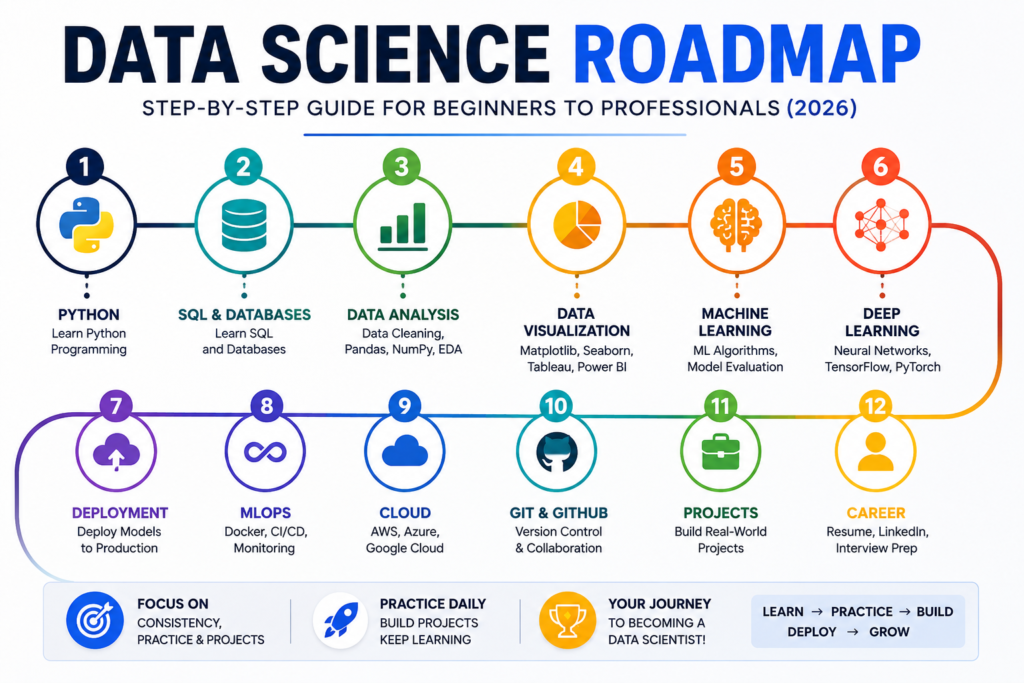
The fastest and most effective path is to:
- Learn Python programming.
- Build a strong understanding of statistics and probability.
- Master SQL for working with databases.
- Learn data analysis with Pandas and NumPy.
- Practice data visualization using Matplotlib, Seaborn, Power BI, or Tableau.
- Study machine learning fundamentals.
- Build real-world projects and publish them on GitHub.
- Learn basic cloud deployment and MLOps concepts.
- Create a professional portfolio.
- Prepare for technical interviews and continuously improve your skills.
Instead of completing dozens of unrelated courses, focus on mastering each stage before moving to the next. Consistent practice and project work are far more valuable than collecting certificates.
What Is Data Science?
Data Science is the process of collecting, cleaning, analyzing, and interpreting data to solve real-world problems and facilitate better decision-making. It combines programming, mathematics, statistics, and business knowledge to uncover valuable insights hidden within large datasets.
For example, consider an online shopping platform that recommends products you might like, or a banking app that detects suspicious transactions before fraud occurs; these systems rely on data science to analyze patterns and make informed predictions.
Simply put, data science transforms raw data into actionable insights that businesses can use to improve their products, reduce costs, and make better decisions.
How Data Science Works
A typical Data Science workflow includes several key steps:
- Collect data from different sources.
- Clean and organize the data.
- Explore the data to identify trends and patterns.
- Build predictive models using machine learning.
- Evaluate model performance.
- Deploy the model into real-world applications.
- Monitor and improve the model over time.
Each stage is important. Poor-quality data, for example, can lead to inaccurate predictions regardless of how advanced the model is.
Why Companies Need Data Scientists
Modern businesses generate enormous amounts of data every day. Without skilled professionals to interpret that data, valuable opportunities can be missed.
Companies hire Data Scientists to:
- Predict customer behavior.
- Improve marketing campaigns.
- Detect fraud and security threats.
- Forecast sales and demand.
- Optimize supply chains.
- Personalize customer experiences.
- Automate decision-making.
As organizations continue investing in digital transformation, the demand for professionals who can extract value from data remains strong across industries.
Real-World Applications of Data Science
Data Science is used in almost every major industry:
| Industry | Example Applications |
|---|---|
| Healthcare | Disease prediction, medical image analysis, personalized treatment |
| Finance | Fraud detection, credit scoring, risk analysis |
| Retail | Product recommendations, inventory forecasting |
| Marketing | Customer segmentation, campaign optimization |
| Manufacturing | Predictive maintenance, quality control |
| Sports | Player performance analysis, injury prevention |
| Education | Personalized learning platforms, student performance analysis |
| Transportation | Route optimization, autonomous vehicles |
These examples highlight how Data Science improves efficiency, reduces costs, and enhances user experiences.
Industry Snapshot: According to reports from organizations such as the World Economic Forum and major employment platforms, data-related roles continue to rank among the fastest-growing careers worldwide. Always refer to the latest editions of these reports for updated employment trends and statistics.
Best Practices
- Focus on solving real business problems rather than memorizing algorithms.
- Build practical projects alongside your learning.
- Develop strong analytical thinking.
- Keep improving your communication skills, as presenting insights is just as important as finding them.
Common Mistakes
Many beginners:
- Rush into machine learning without understanding Python.
- Ignore statistics and probability.
- Spend too much time watching tutorials instead of practicing.
- Build projects by copying code without understanding it.
Avoid these habits, and your learning journey will become much smoother.
Related Reading: Understanding the difference between Artificial Intelligence (AI), Machine Learning (ML), and Data Science can help you choose the right career path and learning strategy.
Why Learn Data Science in 2026?
If you are considering a secure career for the future, data science is certainly worth your attention. Businesses are increasingly becoming data-driven, and there is a demand across every industry for skilled professionals who can analyze information and solve complex problems.
While many careers are tied to a single sector, data science offers opportunities in technology, healthcare, banking, education, manufacturing, entertainment, logistics, government, and many other fields.
Excellent Career Opportunities
From startups to major global corporations, everyone needs professionals who can transform data into actionable insights. As companies adopt advanced technologies, the scope for roles such as data analyst, data scientist, machine learning engineer, analytics engineer, and AI engineer is expanding.
Attractive Salaries
Data science is known for offering lucrative salaries. Although compensation varies based on location, experience, and industry, skilled professionals often earn above-average incomes due to their specialized expertise and the value they bring to companies.
Remote and Global Work Opportunities
Many companies now hire remote data scientists, making it possible to collaborate with international teams from anywhere in the world. This flexibility has made the profession highly appealing to those seeking global career opportunities.
High Future Demand
With the growth of artificial intelligence, cloud computing, and automation, the volume of data generated worldwide is constantly increasing. Companies require experts who can responsibly analyze this data and translate it into critical business decisions.
New technologies are transforming the way data scientists work rather than replacing them—allowing professionals to focus more on solving business problems and interpreting outcomes.
Traditional Careers vs. Data Science
| Factor | Traditional Career | Data Science Career |
|---|---|---|
| Demand | Varies by industry | High across industries |
| Remote Opportunities | Limited in many roles | Widely available |
| Learning Resources | Often formal education | Flexible online learning |
| Skill Growth | Moderate | Continuous and fast-paced |
| Career Flexibility | Industry-specific | Applicable across multiple industries |
Expert Opinion
Hiring managers now place greater importance on practical experience than on mere certifications. Candidates who can demonstrate their problem-solving skills through real-world projects, GitHub repositories, and a strong portfolio are often viewed more favorably than those who have simply completed multiple courses without any practical experience.
Essential Skills to Get Started
A common misconception about data science is that you need to be a math genius or an experienced software developer to begin. In reality, you can start with basic knowledge and gradually build your skills.
Here is what you should focus on first:
Mathematics
Mathematics forms the foundation for understanding many data science techniques.
You don’t need to master every advanced topic immediately, but you should have a solid understanding of the following:
Basic Algebra
Functions and Equations
Introductory Calculus Concepts
Probability
Descriptive Statistics
Inferential Statistics
Correlation and Regression Concepts
Don’t worry if these topics seem difficult at first; learn them gradually by practicing with real-world examples.
Programming
Python is the most popular programming language in data science because it is easy to learn, readable, and boasts a vast ecosystem of libraries.
You need to understand these concepts:
Variables
Data Types
Loops
Conditional Statements
Functions
Lists, Dictionaries, and Sets
File Handling
Object-Oriented Programming (Basic Concepts)
Although R is also used in statistics and research, Python is generally the best starting language for beginners.
SQL
Almost every organization stores data in databases, making SQL an essential skill. Learn how to:
Retrieve data using SELECT
Filter results using WHERE
Sort information using ORDER BY
Combine tables using JOIN
Group data using GROUP BY
Use aggregate functions
Write basic subqueries
Strong SQL skills will significantly enhance your ability to work on real-world projects.
Microsoft Excel
Despite the popularity of modern analytics tools, Excel remains widely used for rapid data analysis, reporting, and visualization.
Key skills include:
Pivot Tables
Charts
Lookup functions
Data cleaning
Conditional formatting
Basic formulas
In many business environments, Excel is often the first tool you encounter.
Communication Skills
Technical knowledge alone is not enough.
A successful data scientist must clearly explain their findings to managers, clients, and stakeholders who may not have a technical background.
Practice:
Writing clear reports.
Creating effective presentations.
Data storytelling.
Explaining complex ideas in simple language.
These skills can significantly impact your career growth.
Checklist for beginners
Before moving to the next stage of your data science journey, ensure you can confidently answer “Yes” to most of these questions:
✅ I understand basic Python programming.
✅ I know basic statistics and probability.
✅ I can write basic SQL queries.
✅ I can use Excel with ease.
✅ I understand how data is collected and organized.
✅ I can solve small programming exercises on my own.
✅ I prefer learning through hands-on practice.
Common mistakes to avoid
Many aspiring data scientists slow down their progress by making these mistakes:
Trying to learn everything at once.
Ignoring basic programming concepts.
Giving up on statistics because it seems difficult.
Watching tutorials for months without building any projects. Comparing one’s progress with that of experienced professionals.
Remember, mastering basic concepts first will make it easier to understand advanced topics.
Complete Data Science Roadmap (Step-by-Step Learning Path)
Now that you understand the basics, it is time to explore the complete learning roadmap. Think of this roadmap like building a house—you cannot construct the roof without laying a solid foundation. Each stage prepares you for the next, making your learning journey more effective and manageable.
Pro Tip: Don’t rush. It is better to master one stage thoroughly than to gain superficial knowledge of five different topics.
Stage 1: Learn Programming Basics (Start with Python)
Python is the most popular programming language in data science because it is beginner-friendly, powerful, and supported by thousands of data science libraries.
What You Should Learn
- Installing Python
- Setting up VS Code or PyCharm
- Jupyter Notebook basics
- Variables and data types
- Operators
- Conditional statements (if, else)
- Loops (for, while)
- Functions
- Modules and packages
- Exception handling
- File handling
- Object-Oriented Programming (OOP) basics
Practice Projects
- Simple Calculator
- Number Guessing Game
- Student Grade Calculator
- Expense Tracker
- Password Generator
- File Organizer
Why It Is Important
Programming is the language you will use to work with data. Without Python, you won’t be able to clean datasets, build models, or automate workflows.
Common Mistakes
- Memorizing syntax without writing code
- Avoiding debugging
- Copy-pasting solutions
- Ignoring coding best practices
Best Practices
- Write code every day.
- Solve beginner coding problems.
- Read other people’s code.
- Build small projects regularly.
Stage 2: Learn Statistics and Probability
Many beginners underestimate statistics because they want to jump straight into machine learning. However, the algorithms make much more sense once you understand the underlying mathematics.
Key Topics
Descriptive Statistics
- Mean
- Median
- Mode
- Variance
- Standard Deviation
Probability
- Probability rules
- Conditional probability
- Bayes’ Theorem
- Random variables
Data Distributions
- Normal Distribution
- Uniform Distribution
- Binomial Distribution
Hypothesis Testing
- Null hypothesis
- Alternative hypothesis
- p-value
- Confidence intervals
Correlation and Regression
Understand how variables affect each other.
Real-world Example
A hospital wants to know if a new drug works better than the existing treatment. Statistical testing helps determine whether the observed improvement is significant or merely due to chance.
Best Practices
- Visualize statistical concepts.
- Practice with real datasets.
- Focus on understanding concepts instead of memorizing formulas.
Stage 3: Master SQL
Almost every data scientist works with databases. Before analyzing data, you need to retrieve it.
Essential SQL Topics
Database Basics
- Tables
- Rows
- Columns
- Primary Keys
- Foreign Keys
CRUD Operations
- Create
- Read
- Update
- Delete
Queries
Learn how to use:
- SELECT
- WHERE
- ORDER BY
- GROUP BY
- HAVING
- LIMIT
SQL Joins
- INNER JOIN
- LEFT JOIN
- RIGHT JOIN
- FULL JOIN
Intermediate SQL
- Common Table Expressions (CTEs)
- Window Functions
- CASE Statements
- Subqueries
Practice Projects
- Sales Database Analysis
- Employee Performance Dashboard
- Customer Segmentation
- E-commerce Reporting
Expert Tip
Most real-world data science projects start with SQL—not machine learning.
Stage 4: Learn Data Cleaning and Data Analysis
Professionals often spend a significant amount of time preparing data before building models. Clean data yields better insights and more reliable predictions.
Learn these libraries
pandas
Use Pandas for:
- Reading CSV files
- Filtering data
- Grouping records
- Aggregations
- Merging datasets
NumPy
Understand:
- Arrays
- Matrix operations
- Mathematical calculations
- Linear algebra basics
Data Cleaning Skills
Learn how to:
- Handle missing values
- Remove duplicate records
- Fix inconsistent formatting
- Detect outliers
- Convert data types
- Normalize data
Feature Engineering
Create better features by:
- Encoding categorical variables
- Scaling numerical values
- Creating new variables
- Extracting useful information from dates and text
Mini Project Ideas
- Netflix Dataset Analysis
- COVID-19 Data Analysis
- Retail Sales Dashboard
- Movie Ratings Analysis
Stage 5: Learn Data Visualization
Visualizing data (using images or graphs) makes it much easier to understand. Effective visualization helps businesses make quick, informed decisions.
Python Libraries
Matplotlib
Best for:
- Line Charts
- Scatter Plots
- Histograms
- Bar Charts
Seaborn
Useful for:
- Heatmaps
- Correlation Matrices
- Distribution Plots
- Pair Plots
- Statistical Visualizations
Business Intelligence Tools
Power BI
Learn to:
- Build dashboards
- Create interactive reports
- Connect multiple data sources
Tableau
Focus on:
- Drag-and-drop analytics
- Executive dashboards
- Storytelling with data
Visualization Best Practices
- Keep charts simple.
- Avoid unnecessary colors.
- Label charts clearly.
- Highlight important insights.
- Choose the right chart type for your data.
Real Example
Instead of displaying a spreadsheet with thousands of rows, use a line chart to show month-over-month sales trends. Decision-makers can identify growth patterns in seconds.
Stage 6: Learn Machine Learning
Machine learning enables computers to recognize patterns and make predictions without being explicitly programmed for every specific situation.
Learn Supervised Learning
Regression
Used to predict continuously changing values.
Examples:
Housing prices
Sales forecasting
Stock price prediction
Classification
Used to categorize data. Examples:
Spam detection
Disease prediction
Customer churn prediction
Learn Unsupervised Learning
Clustering
Applications include:
- Customer segmentation
- Market analysis
- Image grouping
Dimensionality reduction
Understand techniques like Principal Component Analysis (PCA) to simplify high-dimensional data while retaining essential information.
Model Evaluation
Study key metrics such as:
- Accuracy
- Precision
- Recall
- F1 Score
- ROC-AUC
- Mean Squared Error (MSE)
Cross Validation
Learn how testing your model on multiple data subsets increases reliability and reduces overfitting.
Beginner Machine Learning Projects
- House Price Prediction
- Customer Churn Prediction
- Email Spam Classifier
- Loan Approval Prediction
- Movie Recommendation System
Common Mistakes
- Using too many algorithms without understanding them
- Ignoring feature engineering
- Evaluating models using only accuracy
- Forgetting to validate results
Stage 7: Learn Deep Learning
Once you are comfortable with machine learning, move on to deep learning.
Deep learning is particularly useful for solving complex problems involving images, video, audio, and natural language.
Neural Networks
Understand:
- Neurons
- Layers
- Activation Functions
- Forward Propagation
- Backpropagation
CNN (Convolutional Neural Networks)
Used for:
- Image Classification
- Face Recognition
- Medical Imaging
- Object Detection
RNN (Recurrent Neural Networks)
Suitable for:
- Time Series Forecasting
- Speech Recognition
- Sequential Data Analysis
Transformers
Modern Transformer architectures power many advanced applications, such as language understanding, summarization, and content generation.
Learning topics include:
Attention mechanism
Encoder-decoder architecture
Tokenization
Fine-tuning the model
Frameworks
Focus on:
- TensorFlow
- PyTorch
Suggested Projects
- Image Classifier
- Handwritten Digit Recognition
- Sentiment Analysis
- Chatbot
- Text Summarizer
Stage 8: Learn MLOps and Model Deployment
Building a model is just one part of the job. Businesses need models that can be deployed, monitored, and updated in a production environment.
Learn Deployment
Understand how to:
- Save trained models
- Build APIs
- Serve predictions
- Test applications
FastAPI
A lightweight framework for exposing machine learning models as web APIs.
Docker
Package your application so it runs consistently across different environments.
Git and GitHub
Use version control to:
- Track changes
- Collaborate with teams
- Showcase projects
Cloud Platforms
Learn about at least one cloud provider:
AWS
Microsoft Azure
Google Cloud Platform
CI/CD
Understand how Continuous Integration and Continuous Deployment automate testing and deployment pipelines.
Monitoring
Learn to:
- Detect model drift
- Monitor prediction quality
- Track system performance
- Retrain models when necessary
Production Project Ideas
- Movie Recommendation API
- Fraud Detection Service
- Sentiment Analysis Web App
- Customer Churn Prediction Dashboard
Suggested Learning Timeline
Your pace may vary depending on your background and available study time. The following timeline provides a realistic progression.
| Timeline | Learning Goals |
|---|---|
| First 6 Months | Learn Python, SQL, Statistics, Excel, Pandas, NumPy, and complete 4–5 beginner projects. |
| 6–12 Months | Study Data Visualization and Machine Learning, build intermediate projects, create a GitHub portfolio, and participate in Kaggle competitions. |
| 12–18 Months | Learn Deep Learning, MLOps, Cloud deployment, advanced portfolio projects, interview preparation, and contribute to open-source projects. |
Remember: Consistency beats intensity. Studying for one hour every day over a year is often more effective than trying to learn everything in a few weeks.
Best Tools Every Data Scientist Should Learn
Choosing the right tools will make your workflow more efficient and prepare you for real-world projects.
| Tool | Purpose |
|---|---|
| Python | Programming, automation, data analysis, machine learning |
| SQL | Querying and managing databases |
| Jupyter Notebook | Interactive coding, experimentation, and documentation |
| Git | Version control and collaboration |
| GitHub | Portfolio hosting and code sharing |
| Docker | Containerizing applications for consistent deployment |
| Power BI | Business intelligence dashboards and reporting |
| Tableau | Interactive data visualization and storytelling |
| Apache Spark | Processing large-scale datasets efficiently |
| Google Colab | Cloud-based notebook environment with GPU support |
| VS Code | Lightweight and extensible code editor |
Recommended Tool Learning Order
- Python
- Jupyter Notebook
- Git & GitHub
- SQL
- Pandas & NumPy
- Matplotlib & Seaborn
- Power BI or Tableau
- Docker
- Cloud Platform (AWS, Azure, or Google Cloud)
- Apache Spark
Excellent Learning Resources
A solid roadmap requires high-quality learning materials. Instead of relying on just one source, utilize a mix of official documentation, books, hands-on practice, and community engagement.
Books
- Python for Data Analysis by Wes McKinney
- Hands-On Machine Learning with Scikit-Learn, Keras & TensorFlow by Aurélien Géron
- An Introduction to Statistical Learning (free digital edition available)
Online Courses
- University-based Data Science programs
- Cloud provider learning platforms
- Industry-recognized certification courses
Practice Platforms
- Kaggle
- HackerRank
- LeetCode (for SQL and Python)
- DataCamp exercises
- DrivenData competitions
Official Documentation
Always refer to the official documentation for:
- Python
- Pandas
- NumPy
- Scikit-learn
- TensorFlow
- PyTorch
Official documentation is often the most accurate and up-to-date learning resource.
Communities
Join communities where professionals share ideas and solve problems together:
- GitHub
- Stack Overflow
- Reddit data science communities
- LinkedIn groups
- Local meetups and conferences
Learning alongside a community can help you stay motivated, discover best practices, and keep up with industry trends.
Great Data Science Projects to Enhance Your Skills
While learning theory is essential, employers are more interested in what you can build. Practical projects demonstrate your problem-solving abilities, technical skills, and understanding of real-world business challenges.
A strong portfolio should include projects of varying difficulty levels, showcasing your progression from beginner to advanced stages.
Beginner-Level Projects
These projects help you master Python, Pandas, SQL, and data visualization.
Suggested Projects
- Student Performance Analysis
- Titanic Survival Prediction
- Movie Ratings Analysis
- Sales Dashboard
- COVID-19 Data Analysis
- Employee Attendance Dashboard
- Weather Data Analysis
- Personal Expense Tracker
Skills You Will Practice
- Data cleaning
- Exploratory Data Analysis (EDA)
- Data visualization
- Basic statistics
- Python programming
Intermediate-Level Projects
At this stage, focus on machine learning and predictive analytics.
Suggested Projects
- Customer Churn Prediction
- House Price Prediction
- Credit Risk Analysis
- Loan Approval Prediction
- Product Recommendation System
- Sales Forecasting
- Customer Segmentation
- Employee Attrition Prediction
Skills You Will Practice
- Feature engineering
- Model selection
- Model evaluation
- Hyperparameter tuning
- Business interpretation
Advanced-Level Projects
These projects demonstrate production-ready skills.
Suggested Projects
- Real-Time Fraud Detection
- AI Chatbot
- Medical Image Classification
- Stock Market Forecasting
- NLP-based Resume Screening
- Recommendation Engine
- Predictive Maintenance System
- Demand Forecasting Platform
Skills You Will Practice
- Deep Learning
- MLOps
- Cloud deployment
- APIs
- Model monitoring
- Scalability
Portfolio Tips
A robust GitHub repository should include:
- A clean README
- Business problem statement
- Dataset source
- Data cleaning steps
- Model explanation
- Visualizations
- Results
- Future improvements
Quality matters more than quantity. Generally, five excellent projects hold more value than twenty incomplete ones.
How to Build an Impressive Data Science Portfolio
Your portfolio is your professional showcase. Recruiters often review it before scheduling an interview.
Build a personal portfolio website
Include:
- Professional introduction
- Skills
- Featured projects
- Resume
- Contact information
- Blog articles
- Certifications
Maintain an active GitHub profile
Your GitHub should demonstrate consistent learning.
Include:
- Well-organized repositories
- Meaningful commit history
- Documentation
- Clean code
- Project screenshots
Optimize Your Resume
Highlight:
- Technical skills
- Projects
- Certifications
- Internships
- Achievements
- GitHub profile
- Portfolio website
Keep your resume concise and tailored to the role.
Build a Strong LinkedIn Profile
Share:
- Learning progress
- Project updates
- Technical articles
- Certifications
- Industry insights
Networking often leads to opportunities that job boards never advertise.
Develop Your Personal Brand
Consider:
- Writing technical blogs
- Speaking at meetups
- Creating tutorials
- Contributing to open-source projects
- Helping others in developer communities
Personal branding helps establish credibility and increases visibility within the industry.
Data Science Career Paths
Data Science offers multiple career options depending on your interests and strengths.
| Career | Primary Focus | Typical Responsibilities |
|---|---|---|
| Data Analyst | Business insights | Analyze data, create dashboards, generate reports |
| Data Scientist | Predictive analytics | Build models, analyze data, solve business problems |
| Machine Learning Engineer | Production ML | Develop and deploy machine learning systems |
| AI Engineer | Artificial Intelligence | Build AI-powered applications and intelligent systems |
| Data Engineer | Data infrastructure | Design data pipelines and manage large datasets |
| Analytics Engineer | Data modeling | Bridge analytics and engineering for business intelligence |
| Research Scientist | Innovation | Develop new algorithms and conduct advanced research |
Which Role Should You Choose?
- Enjoy dashboards and reports? → Data Analyst
- Love solving business problems? → Data Scientist
- Interested in software engineering? → Machine Learning Engineer
- Passionate about AI applications? → AI Engineer
- Like databases and infrastructure? → Data Engineer
Choose the role that aligns with your interests rather than following trends alone.
Salary Expectations Worldwide
Compensation depends on location, industry, experience, and technical expertise. Instead of focusing on a single salary figure, think in terms of career progression.
| Experience Level | Typical Expectations |
|---|---|
| Beginner | Entry-level positions with structured learning opportunities |
| Mid-Level | Increased responsibility, larger projects, leadership opportunities |
| Senior | Strategic decision-making, mentoring, architecture, and high-impact projects |
Additional earning opportunities include:
- Freelancing
- Remote international work
- Technical consulting
- Online teaching
- Content creation
- Open-source sponsorships
As your expertise grows, specialization in areas such as MLOps, Generative AI, or Data Engineering can further increase career opportunities.
Certifications Worth Considering
Certifications can strengthen your resume, but they should complement—not replace—practical experience.
Some respected certification providers include:
- IBM
- Microsoft
- AWS
- Databricks
- DeepLearning.AI
Should You Get Certified?
Yes, if you want to:
- Validate your skills
- Learn through a structured curriculum
- Improve your resume
- Prepare for cloud-focused roles
However, remember that employers typically prioritize demonstrated skills and project experience over certificates alone.
Common Mistakes Beginners Make
Learning efficiently means avoiding common pitfalls.
1. Skipping Statistics
Machine Learning becomes much easier when you understand statistical concepts.
2. Taking Too Many Courses
Completing numerous courses without practicing often leads to knowledge overload.
Better approach: Complete one course, then build multiple projects.
3. Not Building Projects
Projects transform theoretical knowledge into practical skills.
4. Ignoring GitHub
Recruiters frequently review GitHub profiles to assess coding practices and project quality.
5. Neglecting SQL
SQL is one of the most frequently required skills in data-related job descriptions.
6. Comparing Yourself with Others
Everyone learns at a different pace. Focus on steady progress rather than unrealistic comparisons.
Latest Trends in Data Science
The field evolves rapidly. Staying informed helps you remain competitive.
Generative AI
Organizations are increasingly integrating generative models into workflows for content creation, software development, and customer support.
Large Language Models (LLMs)
LLMs are enabling new applications in natural language understanding, search, and conversational systems.
AutoML
Automated Machine Learning simplifies model selection and optimization, making advanced analytics more accessible.
AI Agents
Autonomous systems capable of planning, reasoning, and executing tasks are becoming an important area of development.
MLOps
As machine learning adoption grows, organizations need reliable deployment, monitoring, and maintenance practices.
Responsible AI
Ethical AI development now emphasizes:
- Fairness
- Transparency
- Privacy
- Security
- Accountability
Synthetic Data
Synthetic datasets help train models while protecting sensitive information and improving privacy.
Edge AI
Running AI models directly on mobile devices, IoT sensors, and embedded systems reduces latency and improves responsiveness.
Future Scope of Data Science
The future of Data Science looks promising as industries continue to embrace digital transformation.
Future opportunities include:
- Healthcare innovation
- Smart manufacturing
- Autonomous transportation
- Climate analytics
- Financial technology
- Cybersecurity
- Personalized education
- Robotics
Professionals who continuously update their skills will be well-positioned to contribute to these evolving fields.
Expert Tips to Learn Data Science Faster
Learning efficiently is about consistency, not speed.
Daily Practice
Dedicate at least one hour each day to coding or data analysis.
Build Projects
Apply every new concept to a practical project.
Join Communities
Engage with professionals through online forums, local meetups, and study groups.
Contribute to Open Source
Collaborating on open-source projects helps improve coding standards and teamwork skills.
Write Technical Blogs
Explaining concepts reinforces your own understanding and builds your professional reputation.
Participate in Competitions
Platforms like Kaggle provide valuable real-world datasets and challenges.
Prepare for Interviews
Practice:
- Python
- SQL
- Statistics
- Machine Learning concepts
- Case studies
- Behavioral questions
Frequently Asked Questions
1. What is the best roadmap for learning Data Science?
Start with Python, statistics, SQL, and data analysis before moving to machine learning, deep learning, and MLOps.
2. Is coding mandatory for Data Science?
Yes. Python is the most commonly used language, and SQL is essential for working with databases.
3. Can I learn Data Science without mathematics?
You can begin without advanced mathematics, but a solid understanding of statistics and probability is important as you progress.
4. Should I learn Python or R first?
Python is generally recommended for beginners because of its versatility and broad industry adoption.
5. Should I learn SQL before Machine Learning?
Yes. SQL is a core skill used in many real-world data science roles.
6. How long does it take to become job-ready?
The timeline varies based on your background, available study time, and project experience. Consistent learners often make significant progress within a year.
7. Is AI replacing Data Scientists?
AI is changing workflows, but organizations still need professionals to define problems, evaluate models, interpret results, and ensure responsible use.
8. Which cloud platform should I learn first?
Choose one—AWS, Microsoft Azure, or Google Cloud—and build a strong foundation before exploring others.
9. Can ChatGPT help me learn Data Science?
It can help explain concepts, generate practice ideas, review code, and assist with debugging, but it should complement—not replace—hands-on learning and official documentation.
10. How important is MLOps?
MLOps is increasingly important because it helps deploy, monitor, and maintain machine learning models in production environments.
Conclusion
Data science is not merely a collection of technical skills—it is a systematic approach to solving critical problems using data. Whether you aspire to become a data scientist, machine learning engineer, AI engineer, or data analyst, success hinges on mastering fundamental principles before advancing to complex concepts.
Start with Python, statistics, and SQL. Build practical projects that showcase your capabilities. Learn to communicate insights clearly, maintain a strong portfolio, and stay eager to learn as the field constantly evolves.
Remember, being job-ready goes beyond simply completing courses; it involves consistently applying what you have learned to real-world challenges. Every project you complete, every dataset you explore, and every problem you solve brings you one step closer to a rewarding career in data science.
Also Read: Techlymate