
Edge AI vs. Cloud AI: Differences, Benefits, Use Cases & Which One Should You Choose?
Introduction
Artificial Intelligence (AI) is no longer a futuristic concept—it powers many of the devices and services we use every day. From unlocking your smartphone with facial recognition to receiving personalized recommendations on streaming platforms, AI is quietly making technology smarter.
However, as AI adoption grows, a critical question has emerged:
Should AI process data directly on devices, or should it rely on powerful cloud servers?
The answer isn’t always straightforward. Choosing the wrong approach can lead to slower performance, higher costs, privacy concerns, or scalability issues.
This is where Edge AI and Cloud AI come into play.
Edge AI focuses on processing data locally, close to where it’s generated, while Cloud AI uses remote data centers to handle AI workloads. Each approach has unique strengths, limitations, and ideal use cases.
In this comprehensive guide, you’ll learn:
- What Edge AI and Cloud AI are
- How they work
- Their key differences
- Performance, privacy, and cost comparisons
- Real-world applications
- When to choose one over the other
- Whether a hybrid AI approach is the future
By the end, you’ll have a clear understanding of which AI deployment model best suits your personal or business needs.
What Is Edge AI?
Quick Definition
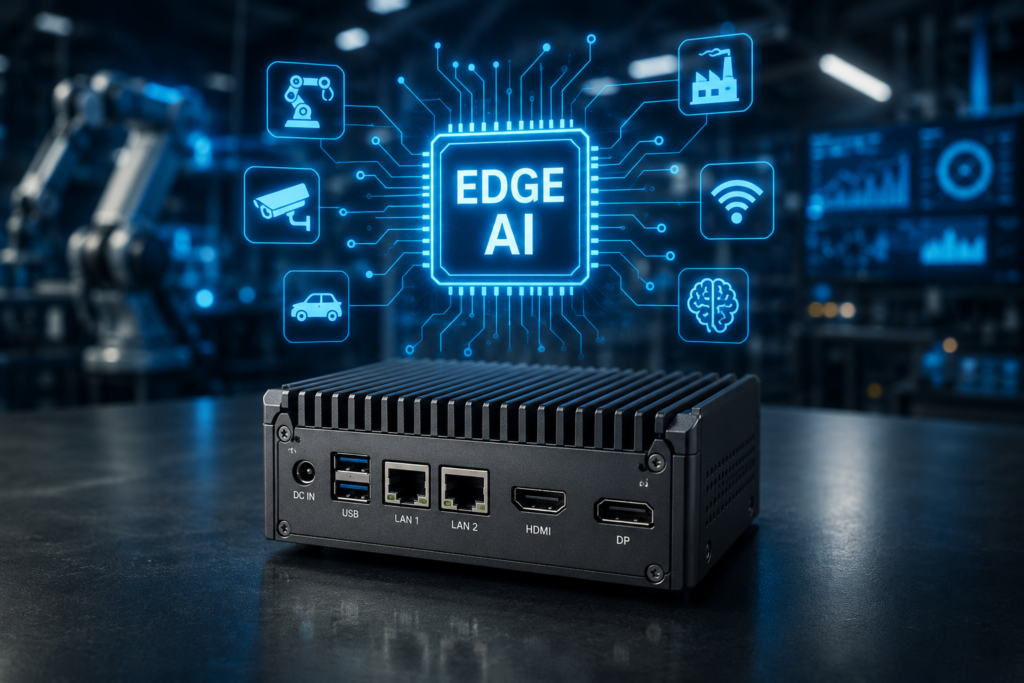
Edge AI is the process of running artificial intelligence directly on local devices—such as smartphones, security cameras, robots, drones, or IoT devices—instead of sending data to remote cloud servers for processing.
The term “edge” refers to devices located at the edge of a network, close to where data is created.
Instead of uploading every piece of information to the cloud, the device analyzes the data itself and makes decisions in real time.
Examples of Edge AI
- Face ID unlocking your smartphone
- Smart security cameras detecting intruders
- Self-driving cars identifying pedestrians
- Smartwatches monitoring heart rate
- Industrial robots inspecting products
- Drones avoiding obstacles during flight
What Is Cloud AI?
Quick Definition
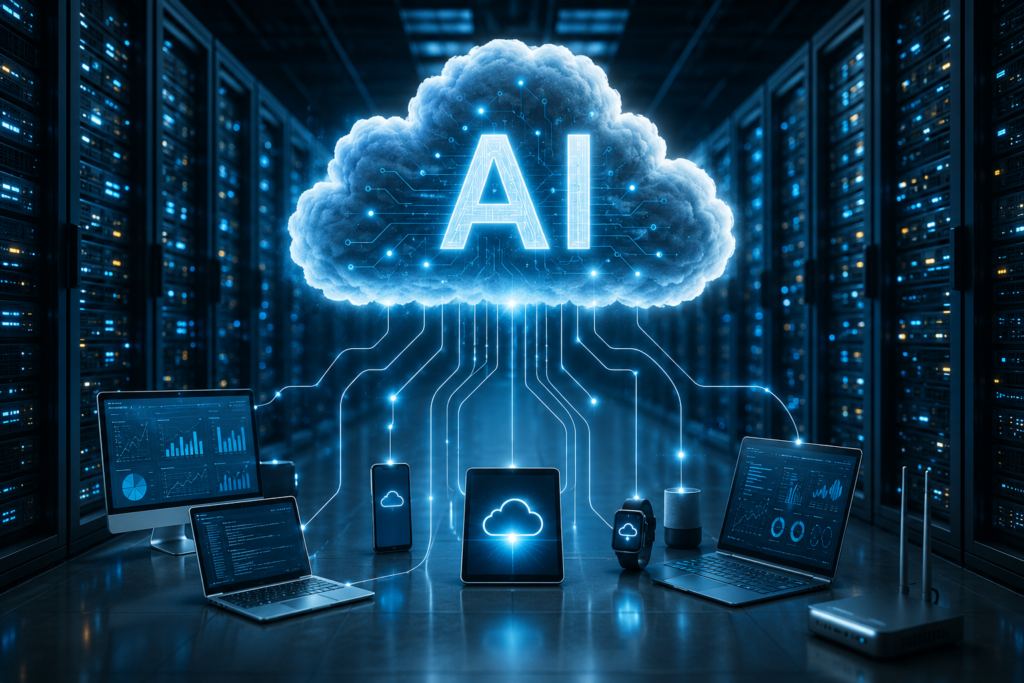
Cloud AI is the process of sending data to remote cloud servers where powerful AI models analyze the information and return the results to the user or device.
Unlike Edge AI, Cloud AI relies on large-scale computing resources located in data centers.
This allows organizations to train and run highly complex AI models that would be impossible to execute on small devices.
Examples of Cloud AI
- AI chatbots
- Online translation services
- Large language models
- Recommendation engines
- Image generation platforms
- Business analytics systems
How Does Edge AI Work?
The Edge AI workflow consists of four simple steps:
Step 1: Data Collection
The device gathers information through built-in sensors, such as:
- Camera
- Microphone
- GPS
- Temperature sensor
- Motion sensor
Step 2: Local AI Processing
A pre-trained AI model stored on the device analyzes the data without sending it to the cloud.
Examples include:
- Image recognition
- Voice recognition
- Object detection
- Gesture recognition
Step 3: Decision Making
The device immediately decides what action to take.
For example:
- Unlock a phone
- Detect a person
- Stop a robot
- Avoid an obstacle
Step 4: Optional Cloud Synchronization
Some Edge AI systems occasionally upload summarized or anonymized data to the cloud for analytics, software updates, or model improvements.
How Does Cloud AI Work?
Cloud AI follows a different workflow.
Step 1: Data Collection
A device captures data from the user or environment.
Step 2: Data Transmission
The information is sent over the internet to cloud servers.
Step 3: AI Processing
Powerful GPUs, TPUs, or AI accelerators process the data using advanced machine learning models.
Step 4: Response
The results are sent back to the user or application.
Examples include:
- AI-generated text
- Language translation
- Recommendation lists
- Fraud detection
- Business insights
Edge AI vs. Cloud AI: Core Differences
Although both technologies use artificial intelligence, their architecture and objectives are quite different.
| Feature | Edge AI | Cloud AI |
|---|---|---|
| Processing Location | Local device | Remote servers |
| Internet Required | Usually optional | Usually required |
| Response Time | Instant | Depends on network |
| Latency | Very low | Medium to high |
| Privacy | Excellent | Moderate |
| Offline Capability | Yes | Limited |
| Scalability | Moderate | Excellent |
| Device Cost | Higher | Lower (device-side) |
| Maintenance | Distributed | Centralized |
| Best Use Cases | Real-time applications | Large-scale analytics |
Edge AI vs. Cloud AI: Speed and Performance
Edge AI
Since processing happens directly on the device, there is almost no communication delay.
This makes Edge AI ideal for:
- Autonomous vehicles
- Industrial automation
- Medical devices
- Robotics
- Smart cameras
Cloud AI
Cloud AI provides tremendous computing power but depends on network quality.
It is best suited for:
- Large AI models
- Enterprise analytics
- Massive databases
- AI model training
- Content generation
Verdict: If your application requires instant responses, Edge AI has the advantage.
Latency Comparison
Latency is the time between an action and the system’s response.
Edge AI
Because data never leaves the device (or travels only a short distance), latency is extremely low—often measured in milliseconds.
Cloud AI
Cloud AI introduces additional delays because data must travel across the internet, be processed in a remote data center, and then return to the device.
For applications where every millisecond matters, such as collision avoidance in autonomous vehicles or industrial safety systems, Edge AI is typically the better choice.
Privacy and Data Security
Privacy is one of the biggest reasons organizations adopt Edge AI.
Edge AI
Sensitive information often remains on the device.
Examples include:
- Fingerprint authentication
- Facial recognition
- Health monitoring
- Smart home devices
This reduces the amount of personal data transmitted over networks.
Cloud AI
Cloud AI sends data to external servers for processing.
Leading cloud providers implement robust security measures, including encryption, access controls, and compliance certifications. However, organizations must still consider regulatory requirements, data residency, and user consent when storing or processing sensitive information in the cloud.
Cost Comparison
The total cost of ownership depends on the use case.
Edge AI Costs
Advantages
- Lower bandwidth usage
- Reduced cloud processing fees
- Fewer recurring server costs
Challenges
- More expensive AI-enabled hardware
- Device maintenance at scale
- On-device software updates
Cloud AI Costs
Advantages
- No need for powerful local hardware
- Easier centralized management
- Flexible pay-as-you-go pricing
Challenges
- Ongoing cloud service fees
- Bandwidth costs
- Potentially higher operational costs for data-intensive workloads
Scalability
Edge AI
Scaling Edge AI requires deploying and managing many individual devices.
While modern device management platforms simplify this process, large deployments still require careful planning.
Cloud AI
Cloud AI excels at scalability.
Organizations can increase computing resources almost instantly, making it ideal for applications serving millions of users.
Real-World Example
Imagine a smart security camera monitoring your home’s entrance.
Using Edge AI
- Detects a person locally
- Identifies movement instantly
- Sends an alert within milliseconds
- Continues working during internet outages
Using Cloud AI
- Uploads video to a cloud server
- AI processes the footage remotely
- Returns the result to the camera or app
The cloud approach may offer more advanced analytics, but it introduces additional latency and depends on a stable internet connection.
Industry Use Cases
Choosing between Edge AI and Cloud AI depends on the industry’s specific needs. Some applications require real-time decision-making, while others benefit from the cloud’s massive computing power.
Healthcare
Healthcare organizations use both Edge AI and Cloud AI to improve patient care.
Edge AI Applications
- Wearable health monitors
- Portable diagnostic devices
- Smart medical equipment
- Emergency response systems
Example: A wearable ECG monitor can detect abnormal heart rhythms instantly and alert the patient without waiting for cloud processing.
Cloud AI Applications
- Medical image analysis
- Hospital data management
- AI-assisted diagnostics
- Population health analytics
Best Choice: A hybrid approach works best, with Edge AI handling immediate patient monitoring and Cloud AI supporting advanced analytics.
Manufacturing
Factories increasingly rely on AI to improve quality and efficiency.
Edge AI
- Machine vision for defect detection
- Predictive maintenance
- Robotic automation
- Worker safety monitoring
Cloud AI
- Production planning
- Supply chain optimization
- Enterprise reporting
- AI model training
Best Choice: Edge AI for factory-floor operations and Cloud AI for business intelligence.
Retail
Retailers use AI to enhance customer experiences and optimize operations.
Edge AI
- Smart checkout systems
- Shelf monitoring
- Customer traffic analysis
- In-store security
Cloud AI
- Personalized recommendations
- Inventory forecasting
- Customer relationship management
- Demand prediction
Transportation
Autonomous vehicles and intelligent transportation systems require rapid decision-making.
Edge AI
- Collision avoidance
- Lane detection
- Traffic sign recognition
- Driver assistance
Cloud AI
- Fleet analytics
- Route optimization
- Traffic forecasting
- Vehicle maintenance insights
Smart Cities
Modern cities combine both technologies.
Edge AI
- Traffic signal control
- Public safety cameras
- Environmental monitoring
- Smart lighting
Cloud AI
- City-wide analytics
- Infrastructure planning
- Utility management
- Public service optimization
Internet of Things (IoT)
IoT devices generate enormous amounts of data.
Edge AI
Processes data directly on devices such as:
- Smart thermostats
- Security cameras
- Industrial sensors
- Agricultural equipment
Cloud AI
Aggregates data from thousands of connected devices to identify trends and improve decision-making.
Hybrid AI: The Best of Both Worlds
Many organizations don’t choose one technology over the other. Instead, they combine Edge AI and Cloud AI in a hybrid architecture.
How Hybrid AI Works
- Devices process time-sensitive tasks locally using Edge AI.
- Important or summarized data is securely sent to the cloud.
- Cloud AI performs deeper analysis, stores historical data, and trains improved AI models.
- Updated models are deployed back to edge devices.
Benefits of Hybrid AI
- Faster response times
- Improved privacy
- Better scalability
- Reduced bandwidth usage
- Continuous AI model improvement
This approach is becoming increasingly common in industries such as healthcare, manufacturing, logistics, and smart cities.
Advantages and Disadvantages
Edge AI
Advantages
- Real-time processing
- Very low latency
- Better privacy
- Reduced bandwidth usage
- Works offline
- Faster response times
- Lower long-term cloud costs
Disadvantages
- Limited computing power
- Higher hardware costs
- More complex device management
- Challenging software updates
- Battery and power constraints
Cloud AI
Advantages
- Virtually unlimited computing power
- Easy scalability
- Centralized management
- Simplified software updates
- Ideal for training large AI models
- Access to powerful cloud services
Disadvantages
- Internet dependency
- Higher latency
- Ongoing cloud costs
- Potential privacy concerns
- Increased bandwidth usage
Edge AI vs. Cloud AI: Feature Comparison
| Feature | Edge AI | Cloud AI |
|---|---|---|
| Processing Speed | ⭐⭐⭐⭐⭐ | ⭐⭐⭐⭐ |
| Latency | ⭐⭐⭐⭐⭐ | ⭐⭐⭐ |
| Privacy | ⭐⭐⭐⭐⭐ | ⭐⭐⭐ |
| Security | ⭐⭐⭐⭐ | ⭐⭐⭐⭐ |
| Scalability | ⭐⭐⭐ | ⭐⭐⭐⭐⭐ |
| Computing Power | ⭐⭐⭐ | ⭐⭐⭐⭐⭐ |
| Offline Capability | ⭐⭐⭐⭐⭐ | ⭐⭐ |
| Cost Efficiency | ⭐⭐⭐⭐ | ⭐⭐⭐⭐ |
| Maintenance | ⭐⭐⭐ | ⭐⭐⭐⭐⭐ |
| AI Model Training | ⭐ | ⭐⭐⭐⭐⭐ |
When Should You Choose Edge AI?
Edge AI is the better option if your application requires:
- Instant decision-making
- Offline functionality
- Strong privacy
- Low latency
- Real-time video analysis
- Autonomous systems
- Wearable devices
- Industrial automation
Examples
- Autonomous vehicles
- Smart security cameras
- Medical wearables
- Drones
- Smart factories
- Robotics
When Should You Choose Cloud AI?
Cloud AI is the right choice when you need:
- Large-scale AI model training
- Massive data processing
- Centralized management
- Business analytics
- Global scalability
- AI-powered enterprise applications
Examples
- Customer support chatbots
- Recommendation systems
- Fraud detection
- Enterprise reporting
- AI content generation
- Data science platforms
Future Trends
Several technology trends are shaping the future of AI deployment.
More Powerful AI Chips
Specialized AI processors are becoming faster, smaller, and more energy-efficient, enabling advanced AI capabilities on everyday devices.
Smarter Edge Devices
Smartphones, cameras, and IoT devices will increasingly perform AI tasks without relying heavily on cloud connectivity.
Growth of Hybrid AI
Organizations are expected to combine Edge AI and Cloud AI to achieve the best balance of speed, privacy, and scalability.
AI in 5G and Beyond
Faster wireless networks will improve communication between edge devices and cloud platforms, enabling new applications such as connected vehicles and smart infrastructure.
Expert Recommendations
Based on current industry practices:
Choose Edge AI if you prioritize:
- Speed
- Privacy
- Offline operation
- Real-time decision-making
Choose Cloud AI if you prioritize:
- Large-scale processing
- Centralized AI management
- Advanced analytics
- Continuous model training
Choose Hybrid AI if you need:
- The speed of Edge AI
- The scalability of Cloud AI
- Long-term flexibility
- Enterprise-grade performance
For many organizations, a hybrid architecture provides the most balanced and future-ready solution.
Conclusion
Edge AI and Cloud AI are not competing technologies—they are complementary approaches to deploying artificial intelligence.
Edge AI excels at delivering fast, low-latency, and privacy-focused experiences directly on devices. Cloud AI, on the other hand, offers unmatched computing power, centralized management, and the ability to process vast amounts of data.
The right choice depends on your specific requirements. If your application demands instant responses and reliable offline performance, Edge AI is often the better option. If your goal is large-scale analytics, AI model training, or serving millions of users, Cloud AI remains the preferred solution.
As AI continues to evolve, hybrid architectures that combine the strengths of both approaches are becoming the industry standard. By understanding these technologies today, businesses and developers can make informed decisions and build AI solutions that are efficient, secure, and ready for the future.
Also Read: Techlymate