
Full Stack Developer vs Web Developer: What's the Difference and Which Career Is Better?
Introduction
Have you decided to become a developer but are struggling to choose between the roles of a web developer and a full-stack developer? You are not alone; thousands of newcomers starting a career in technology face this very question.
Choosing the wrong learning path can lead to confusion, wasted time, and frustration. Many people jump to advanced frameworks without grasping the fundamentals, while others fail to determine exactly which skills employers are looking for.
The good news is that both career paths offer excellent opportunities. What matters is understanding the differences between them, the nature of the work involved in each role, and which path best aligns with your interests and career goals.
In this guide, you will learn the real differences between full-stack developers and web developers, compare their responsibilities, required skills, salary expectations, job demand, and career growth prospects, and decide which path is right for you in 2026.
What Is a Web Developer?
A web developer is a professional who builds, maintains, and improves websites or web applications. Depending on their specific role, a web developer may specialize in front-end, back-end, or both.
Web developers focus on creating websites that are functional, user-friendly, and secure, and that operate correctly across various devices.
Types of Web Developers
The term “web developer” is broad and encompasses several specializations.
1. Front-End Developer
Front-end developers build the part of a website that users see and interact with.
Typical responsibilities include:
- Designing page layouts
- Creating responsive interfaces
- Building navigation menus
- Optimizing user experience
- Improving website performance
Common technologies:
- HTML
- CSS
- JavaScript
- React
- Vue.js
- Angular
- Tailwind CSS
2. Back-End Developer
Back-end developers work behind the scenes. They create the systems that power websites and web applications.
Their responsibilities include:
- Building APIs
- Managing databases
- Writing server-side logic
- Handling authentication and security
- Processing user requests
- Integrating third-party services
Common technologies:
- Node.js
- Python
- PHP
- Java
- C#
- Express.js
- Django
- Laravel
- Spring Boot
Databases commonly used:
- MySQL
- PostgreSQL
- MongoDB
- SQL Server
3. Full Stack Developer
A full-stack developer combines front-end and back-end skills to build complete web applications. We’ll explore this role in detail next.
What Does a Web Developer Do?
A web developer’s day-to-day work may include:
- Creating new websites
- Updating existing websites
- Fixing bugs
- Improving page speed
- Building responsive layouts
- Optimizing website security
- Testing functionality
- Collaborating with designers and product teams
- Integrating APIs
- Maintaining web servers (depending on the role)
Skills Required to Become a Web Developer
Core Technical Skills
- HTML5
- CSS3
- JavaScript
- Responsive Design
- Git & GitHub
- Browser Developer Tools
- Basic SEO knowledge
- Accessibility best practices
Soft Skills
- Problem-solving
- Communication
- Time management
- Attention to detail
- Teamwork
- Continuous learning
What Is a Full Stack Developer?
A full-stack developer is a software developer capable of building both the front-end (user interface) and back-end (server, database, and application logic) of a web application.
Unlike specialists who focus on only one part of a project, full-stack developers understand how all the layers work together, enabling them to create a complete web solution from start to finish.
Definition Box
Web Developer: A broad term for professionals who build websites or web applications. They may specialize in front-end, back-end, or full-stack development.
Full Stack Developer: A developer with the skills to work across the entire web application stack, including user interface, server-side logic, databases, APIs, deployment, and basic DevOps practices.
Why Full Stack Developers Are in High Demand
Many companies, especially startups and small businesses, value developers who can contribute across multiple parts of a project. A full-stack developer can:
- Build user interfaces
- Develop APIs
- Design database structures
- Connect front-end and back-end systems
- Fix issues across the application
- Deploy projects to cloud platforms
- Collaborate effectively with cross-functional teams
This versatility can make full stack developers particularly valuable in smaller teams, although larger organizations may still prefer specialized roles for complex projects.
Common Full Stack Technology Stacks
Different organizations use different technology stacks. Some of the most common include:
| Stack | Technologies |
|---|---|
| MERN | MongoDB, Express.js, React, Node.js |
| MEAN | MongoDB, Express.js, Angular, Node.js |
| LAMP | Linux, Apache, MySQL, PHP |
| Django | Python, Django, PostgreSQL |
| Java Stack | Java, Spring Boot, MySQL |
| .NET Stack | C#, ASP.NET Core, SQL Server |
Expert Tip
If you are starting your development journey, build a strong grasp of HTML, CSS, and JavaScript before moving on to frameworks like React or backend technologies like Node.js. Mastering the basics makes learning advanced tools much easier and prepares you to better solve real-world development problems.
Full Stack Developer vs Web Developer: Quick Comparison
If you’re short on time, here’s a quick overview.
| Feature | Web Developer | Full Stack Developer |
|---|---|---|
| Definition | Builds websites or specializes in front-end or back-end development | Builds complete web applications from front-end to back-end |
| Scope | Can specialize in one area | Works across the entire application stack |
| Front-End Skills | Yes (if front-end role) | Yes |
| Back-End Skills | Yes (if back-end role) | Yes |
| Database Knowledge | Depends on specialization | Required |
| API Development | Depends on role | Required |
| Deployment Knowledge | Basic to intermediate | Usually required |
| Learning Difficulty | Easier for beginners | More challenging |
| Career Flexibility | Good | Excellent |
| Typical Team Role | Specialist | Generalist or end-to-end developer |
The main difference between a web developer and a full-stack developer is that a web developer may specialize in either front-end or back-end development, whereas a full-stack developer is capable of building and maintaining both parts of a web application.
Roles and Responsibilities
Web Developer Responsibilities
A web developer’s tasks vary depending on their specialization.
Front-End Web Developer
Responsibilities include:
- Building responsive websites
- Implementing user interface (UI) designs
- Improving user experience (UX)
- Optimizing website speed
- Ensuring cross-browser compatibility
- Fixing visual bugs
- Improving accessibility
Back-End Web Developer
Responsibilities include:
- Creating APIs
- Managing databases
- Building authentication systems
- Writing server-side code
- Improving application security
- Optimizing performance
- Integrating third-party services
Full Stack Developer Responsibilities
A full-stack developer often handles both client-side and server-side development.
Typical responsibilities include:
- Designing responsive interfaces
- Building reusable front-end components
- Creating REST or GraphQL APIs
- Managing databases
- Implementing authentication and authorization
- Testing applications
- Deploying projects to cloud platforms
- Monitoring application performance
- Fixing bugs across the full stack
- Collaborating with designers, QA engineers, and product managers
Skills Comparison
| Skill | Web Developer | Full Stack Developer |
|---|---|---|
| HTML | ✔ | ✔ |
| CSS | ✔ | ✔ |
| JavaScript | ✔ | ✔ |
| React / Angular / Vue | Usually | ✔ |
| Node.js | Optional | ✔ |
| Database Management | Depends | ✔ |
| SQL | Depends | ✔ |
| MongoDB | Depends | ✔ |
| APIs | Depends | ✔ |
| Authentication | Sometimes | ✔ |
| Git & GitHub | ✔ | ✔ |
| Cloud Deployment | Optional | Recommended |
| Docker | Rarely required | Increasingly valuable |
| CI/CD Basics | Optional | Helpful |
| Testing | Basic | More extensive |
Programming Languages You Should Learn
For Web Developers
Start with:
- HTML
- CSS
- JavaScript
Then learn one framework such as:
- React
- Vue
- Angular
Back-end developers can add:
- PHP
- Python
- Java
- Node.js
- C#
For Full Stack Developers
A common learning path is:
Front End
- HTML
- CSS
- JavaScript
- React
Back End
- Node.js
- Express.js
Database
- MongoDB
- MySQL
- PostgreSQL
Version Control
- Git
- GitHub
Deployment
- Vercel
- Netlify
- Render
- Docker (optional but useful)
Learning Roadmap Comparison
| Stage | Web Developer | Full Stack Developer |
|---|---|---|
| HTML & CSS | ✔ | ✔ |
| JavaScript | ✔ | ✔ |
| Responsive Design | ✔ | ✔ |
| Git | ✔ | ✔ |
| Framework | ✔ | ✔ |
| Backend | Optional | ✔ |
| Database | Optional | ✔ |
| APIs | Optional | ✔ |
| Deployment | Recommended | ✔ |
Salary Comparison (General Trends)
Salaries vary based on location, experience, company size, and technical skills.
| Experience | Web Developer | Full Stack Developer |
|---|---|---|
| Beginner | ₹40,000,0–₹70,0000/year | ₹50,0000–₹75,0000/year |
| Mid-Level | ₹60,0000–₹10,0000/year | ₹80,0000–₹11,00000/year |
| Senior | ₹10,00000–₹14,00000+/year | ₹11,00000–₹16,00000+/year |
Note: These are broad estimates and can differ significantly by country, industry, and specialization.
Key Takeaway
Full-stack developers often command higher salaries because they can contribute to multiple parts of a project. However, in some organizations, highly experienced front-end or back-end specialists can earn just as much—or even more.
Job Demand
Web Developer Demand
Demand remains strong because nearly every business needs websites or web applications.
Common industries include:
- E-commerce
- Healthcare
- Finance
- Education
- Government
- SaaS
- Media
Full Stack Developer Demand
Full stack developers are especially sought after by:
- Startups
- SaaS companies
- Product-based businesses
- Software agencies
- Small and medium-sized businesses
Their ability to handle multiple responsibilities can reduce hiring costs and speed up development.
Career Growth
Web Developer Career Path
Junior Web Developer
↓
Web Developer
↓
Senior Web Developer
↓
Lead Developer
↓
Engineering Manager
Full Stack Developer Career Path
Junior Full Stack Developer
↓
Full Stack Developer
↓
Senior Full Stack Developer
↓
Technical Lead
↓
Software Architect
↓
Engineering Manager
Some developers also transition into:
- DevOps
- Cloud Engineering
- Solutions Architecture
- Product Engineering
- Technical Consulting
Which Career Is Easier?
Web Developer
Pros:
- Simpler learning curve
- Faster entry into the job market
- Focus on one specialization
- Easier to build expertise in a specific area
Best for:
- Complete beginners
- Students
- Career changers
- Freelancers starting out
Full Stack Developer
Pros:
- Broader skill set
- Greater flexibility
- More end-to-end project ownership
- Strong demand in startups and smaller teams
Challenges:
- Requires learning more technologies
- Continuous learning is essential
- Can feel overwhelming at first
Pros and Cons
Web Developer
Pros
- Easier learning path
- Faster to become job-ready
- Opportunity to specialize deeply
- Strong job demand
- Good freelance opportunities
Cons
- Narrower technical scope
- Some roles require collaboration for end-to-end projects
- Advanced specialization may be needed for higher-level positions
Full Stack Developer
Pros
- Versatile skill set
- Can build complete applications
- Excellent career flexibility
- Valuable in startups and product teams
- Strong long-term growth potential
Cons
- Longer learning journey
- More technologies to maintain
- Requires continuous upskilling
Real-World Scenario
Imagine a startup launching a food delivery platform.
A Front-End Web Developer Would:
- Build the customer interface
- Create responsive pages
- Design interactive dashboards
- Improve user experience
A Back-End Web Developer Would:
- Develop the order system
- Manage user accounts
- Handle payments
- Store restaurant and customer data
A Full Stack Developer Could:
- Build the user interface
- Create the backend APIs
- Design the database
- Connect payment systems
- Deploy the application
- Fix issues across the entire project
This illustrates why full stack developers are often valued in smaller teams that need broader technical coverage.
Which Career Should You Choose?
Choose Web Development if you:
- Prefer mastering one area
- Enjoy UI design or server-side programming
- Want a quicker path into the industry
- Plan to specialize in front-end or back-end work
Choose Full Stack Development if you:
- Enjoy understanding how complete systems work
- Like solving problems across different layers of an application
- Want to build complete web apps independently
- Are comfortable learning multiple technologies over time
Expert Recommendations
- Start with HTML, CSS, and JavaScript before exploring frameworks.
- Build several small projects to reinforce your skills.
- Learn Git and maintain a portfolio on GitHub.
- Focus on understanding concepts rather than memorizing syntax.
- Once comfortable with the basics, choose either a specialization or continue toward full stack development based on your interests and career goals.
Complete Learning Roadmap (6–12 Months)
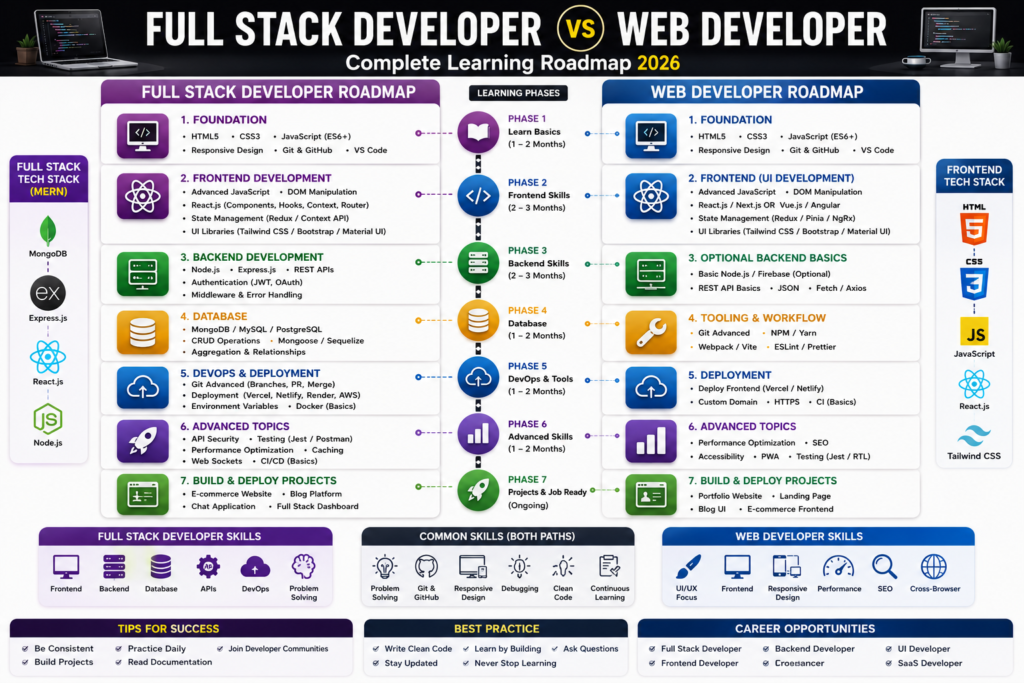
If you’re starting from scratch, don’t try to learn everything at once. Build your skills step by step.
Month 1–2: Learn the Fundamentals
Focus on:
- HTML5
- CSS3
- Responsive Design
- JavaScript (Basics)
- Git
- GitHub
Build These Projects
- Personal Portfolio
- Landing Page
- Restaurant Website
- Travel Website
- Blog Homepage
Month 3–4: Learn JavaScript Deeply
Topics:
- DOM Manipulation
- ES6+
- Fetch API
- Async/Await
- Local Storage
- Form Validation
Projects
- Weather App
- Calculator
- To-Do App
- Quiz Application
- Expense Tracker
Month 5–6: Learn React
Topics:
- Components
- Props
- State
- Hooks
- Routing
- API Integration
Projects
- Movie App
- E-commerce UI
- Dashboard
- Portfolio
- Blog CMS Frontend
Month 7–9: Learn Backend
Topics
- Node.js
- Express.js
- REST APIs
- Authentication
- JWT
- CRUD Operations
Projects
- Authentication System
- Blog API
- Task Manager
- Notes App
Month 10–12: Databases & Deployment
Learn
- MongoDB
- PostgreSQL
- SQL Basics
- Cloud Deployment
- Environment Variables
- Security Best Practices
Deploy Projects On
- Vercel
- Netlify
- Render
- Railway
- GitHub Pages (static sites)
Suggested Portfolio Projects
A strong portfolio is often more valuable than certificates alone.
Beginner Projects
- Personal Portfolio
- Calculator
- Landing Page
- Blog Website
- Responsive Business Website
Intermediate Projects
- Weather Dashboard
- Movie Finder
- Notes App
- Expense Tracker
- Chat Application
Advanced Projects
- E-commerce Store
- Learning Management System
- Food Delivery Platform
- Hotel Booking Website
- Social Media Dashboard
- Job Portal
- Project Management Tool
- SaaS Dashboard
Common Mistakes Beginners Make
Avoid these pitfalls to learn more effectively.
1. Skipping HTML and CSS
A solid foundation makes advanced frameworks easier to understand.
2. Learning Too Many Frameworks at Once
Master one framework before moving to another.
3. Watching Tutorials Without Building Projects
Learning happens through practice.
4. Ignoring Git and GitHub
Version control is an essential professional skill.
5. Not Reading Documentation
Official documentation is one of the most reliable learning resources.
6. Chasing Every New Trend
Focus on core concepts before exploring every new library or framework.
7. Avoiding Debugging
Debugging improves problem-solving skills and builds confidence.
Best Free Learning Resources
Official Documentation
- MDN Web Docs
- React Documentation
- Node.js Documentation
- Express Documentation
- MongoDB Documentation
- Git Documentation
Practice Platforms
- freeCodeCamp
- The Odin Project
- Codecademy (Free Lessons)
- Frontend Mentor
- Exercism
- LeetCode (Basic Practice)
- HackerRank
Best Certifications
While certifications are not mandatory, they can strengthen your profile.
Examples include:
- Meta Front-End Developer Professional Certificate
- IBM Full Stack Software Developer Professional Certificate
- Google UX Design Professional Certificate (for UI/UX understanding)
- Microsoft Learn developer paths
- AWS Cloud Practitioner (for cloud fundamentals)
Expert Career Advice
Based on current hiring trends:
Choose Web Development If
- You enjoy design and user interfaces.
- You prefer specializing in one area.
- You want to enter the job market quickly.
Choose Full Stack Development If
- You enjoy solving end-to-end problems.
- You want to build complete web applications.
- You are comfortable learning continuously.
- You want flexibility across different types of projects.
Final Verdict
Choosing between a web developer and a full-stack developer role depends on your career goals—not on which title sounds more impressive.
If you prefer focusing on a specific area, web development offers a solid and rewarding career path. Specializing in front-end or back-end development can open up excellent career opportunities.
If you enjoy understanding how entire applications function and desire the freedom to build projects from start to finish, full-stack development is a great long-term investment.
Regardless of the path you choose, prioritize the following:
- Strong fundamentals
- Real-world projects
- Consistent practice
- Clean and organized code
- Continuous learning
Technology evolves rapidly, but developers who have a firm grasp of core principles remain valuable throughout their careers.
Frequently Asked Questions (FAQs)
1. What is the main difference between a full stack developer and a web developer?
A web developer is a broad category that may include front-end, back-end, or full-stack roles. A full-stack developer specifically works on both the client-side and server-side of web applications.
2. Who earns more, a web developer or a full stack developer?
Compensation varies by experience, specialization, and location. Full-stack developers often earn more because of their broader skill set, but experienced specialists can earn equally competitive salaries.
3. Is full stack development difficult?
It requires learning more technologies than a specialized role, so it can take longer. A structured roadmap and regular practice make the process manageable.
4. Can I become a full stack developer without a degree?
Yes. Many successful developers are self-taught or graduated from coding bootcamps. Employers often value demonstrable skills and project experience.
5. Which programming language should I learn first?
JavaScript is an excellent first language for aspiring web developers because it is used for both front-end and back-end development.
6. Is full stack development a good career in 2026?
Yes. Organizations continue to hire full stack developers for web applications, SaaS products, startups, and enterprise solutions.
7. Which is better for freelancing?
Both are viable. Full-stack developers may be able to take on complete client projects independently, while specialized web developers can also build successful freelance careers by focusing on a niche.
8. How long does it take to become job-ready?
Many learners become ready for entry-level roles within 6–12 months of consistent study and project work, though timelines vary based on prior experience and learning pace.
9. Should I learn React before Node.js?
Learning HTML, CSS, and JavaScript first is recommended. After that, many learners study React before moving to Node.js and backend development.
10. Is AI replacing web developers?
AI is changing how developers work by assisting with coding, debugging, and documentation, but skilled developers remain essential for architecture, problem-solving, security, and delivering business value.
Also Read: Techlymate