
What Is Content Marketing? The Complete Beginner's Guide (2026)
Introduction
Imagine spending hundreds or even thousands of dollars on ads, only to see visitors leave your website without taking any action. It’s frustrating, especially when your business has something valuable to offer. Many companies face this challenge because they focus on selling before building trust.
Traditional advertising alone is no longer enough. Today’s customers research products, compare options, read reviews, and look for helpful information before making a purchase. If your business isn’t providing that information, potential customers are likely to choose a competitor who does.
This is where content marketing makes a difference.
Instead of interrupting people with promotional messages, content marketing attracts them by offering useful, relevant, and engaging content. Whether it’s a blog post, video, podcast, infographic, or email newsletter, valuable content helps answer questions, solve problems, and build credibility over time.
In this complete beginner’s guide, you’ll learn exactly what content marketing is, how it works, why it’s one of the most powerful digital marketing strategies today, and how you can use it to grow your website, improve your Google rankings, generate qualified leads, and build long-term customer relationships.
What Is Content Marketing?
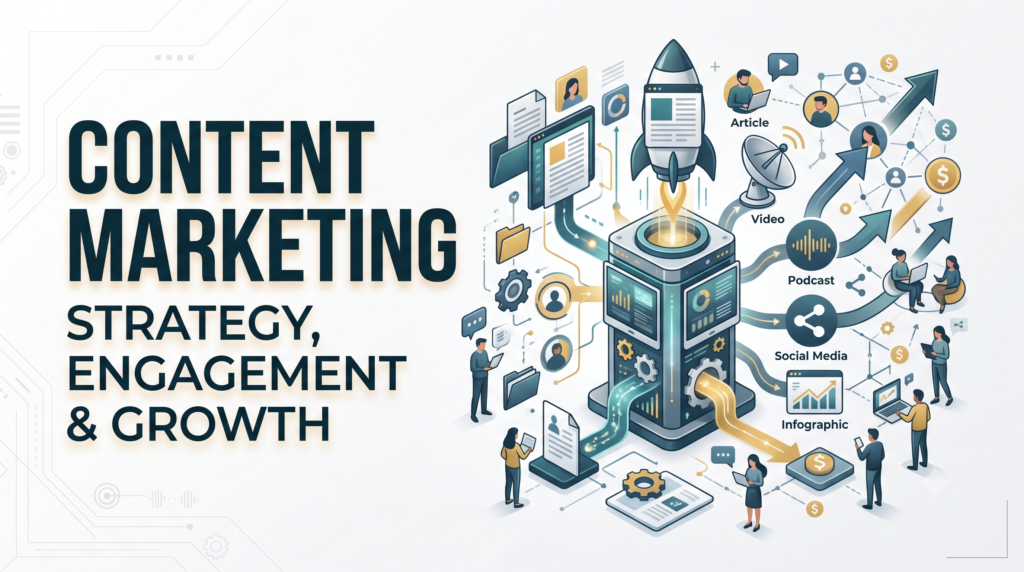
Content marketing is a digital marketing strategy that involves creating and sharing valuable, relevant, and consistent content to attract, engage, and retain a target audience. The ultimate goal is to build trust, increase brand awareness, generate leads, and drive profitable customer actions.
Unlike traditional advertising, content marketing doesn’t focus on pushing products. Instead, it provides useful information that helps people solve problems or make informed decisions.
For example:
- A fitness brand publishes workout guides.
- A software company creates tutorial videos.
- A travel website shares destination guides.
- An online store publishes buying guides.
- A finance company offers budgeting tips.
In every case, the business earns trust first, making customers more likely to choose its products or services later.
Why Content Marketing Matters
Today’s consumers expect brands to educate and support them rather than simply advertise. Every search on Google represents a question, a need, or a problem waiting for an answer. Businesses that consistently provide valuable answers are more likely to earn attention and loyalty.
Content marketing supports every stage of the customer journey—from awareness to purchase and beyond. Helpful blog posts can introduce new visitors to your brand, comparison articles can help them evaluate options, and in-depth guides or tutorials can encourage them to become paying customers.
It also complements other digital marketing channels. High-quality content improves SEO, provides material to share on social media, supports email campaigns, and gives sales teams valuable resources to answer customer questions.
Key Reasons Content Marketing Is Important
- Builds trust and credibility
- Improves search engine visibility
- Attracts organic website traffic
- Generates qualified leads
- Supports long-term business growth
- Reduces dependence on paid advertising
- Encourages customer loyalty
- Strengthens brand authority
- Helps educate potential buyers
- Delivers long-term return on investment (ROI)
How Does Content Marketing Work?
Content marketing follows a structured process that focuses on attracting the right audience with helpful information.
Step 1: Understand Your Audience
Start by identifying who you want to reach. Research your audience’s goals, challenges, interests, and search behavior. Creating detailed buyer personas helps you produce content that addresses real needs.
Example: A travel blog targeting first-time travelers might publish articles about visa requirements, packing checklists, and budget travel tips.
Step 2: Create Valuable Content
Develop content that answers common questions, solves problems, or provides practical advice. Choose formats that suit your audience, such as blog posts, videos, podcasts, or downloadable guides.
Step 3: Optimize for Search Engines
Use relevant keywords naturally in your headings, subheadings, and body text. Structure your content clearly, include descriptive titles, optimize images with alt text, and ensure your pages load quickly.
Step 4: Publish and Promote
Share your content through multiple channels:
- Your website
- Email newsletters
- Social media platforms
- Online communities
- Industry forums
Promotion helps your content reach a wider audience and encourages engagement.
Step 5: Measure Performance
Track important metrics, including:
- Organic traffic
- Time on page
- Bounce rate
- Keyword rankings
- Lead generation
- Conversion rate
- Social shares
- Backlinks
Analyzing these metrics allows you to improve future content and focus on what delivers the best results.
The Core Components of Content Marketing
Successful content marketing is built on several essential elements that work together to attract, engage, and convert your audience.
Audience Research
Understand your ideal customer’s needs, interests, and search intent before creating content.
Content Planning
Develop a content calendar that outlines topics, publishing schedules, and target keywords.
Content Creation
Produce original, high-quality content that is accurate, engaging, and aligned with user intent.
SEO Optimization
Optimize content with relevant keywords, internal links, descriptive headings, image alt text, and structured formatting to improve visibility in search results.
Content Distribution
Promote your content across channels where your audience spends time, such as social media, email, and industry communities.
Performance Analysis
Review analytics regularly to identify successful content, uncover opportunities, and refine your strategy.
Why Businesses Invest in Content Marketing
Businesses of all sizes use content marketing because it delivers lasting value. Unlike paid ads that stop generating traffic when the budget ends, high-quality content can continue attracting visitors for months or even years.
Content marketing also helps businesses:
- Build stronger customer relationships
- Establish industry expertise
- Support every stage of the buying journey
- Increase organic traffic over time
- Improve conversion rates through education
- Differentiate themselves from competitors
For many organizations, content marketing becomes a long-term asset that consistently generates awareness, leads, and sales while strengthening their online presence.
Types of Content Marketing
There is no one-size-fits-all approach to content marketing. Different types of content serve different purposes and appeal to different audiences. The most successful businesses use a mix of content formats to reach people at every stage of the customer journey.
Let’s explore the most effective types of content marketing.
1. Blog Content Marketing
Blogging remains one of the most powerful content marketing strategies. A well-written blog helps answer user questions, improves SEO, and establishes your website as a trusted resource.
Benefits of Blogging
- Increases organic traffic
- Targets long-tail keywords
- Builds authority
- Generates leads
- Supports internal linking
- Provides content for social media
Example
A travel website publishes articles like:
- Best Places to Visit in Japan
- How to Travel Europe on a Budget
- Complete Visa Guide for Canada
Each article attracts visitors searching for those topics on Google.
2. Video Content Marketing
Video is one of the fastest-growing content formats. People often prefer watching a short video over reading a long article.
Popular video formats include:
- Tutorials
- Product demonstrations
- Webinars
- Customer testimonials
- Explainer videos
- Live streams
- Behind-the-scenes videos
Example
A software company creates YouTube tutorials showing users how to use its platform.
3. Social Media Content Marketing
Social media helps businesses connect with audiences where they spend much of their time online.
Popular platforms include:
- X (formerly Twitter)
- TikTok
- Threads
Effective social content includes:
- Short videos
- Carousel posts
- Tips
- Polls
- Stories
- Infographics
- User-generated content
4. Email Marketing
Email remains one of the highest ROI digital marketing channels.
Businesses use email to:
- Share blog posts
- Send newsletters
- Promote products
- Educate subscribers
- Announce updates
- Build long-term relationships
Unlike social media, your email list is an owned audience that you control.
5. Infographics
Infographics present complex information visually.
They work well for:
- Statistics
- Timelines
- Step-by-step guides
- Comparisons
- Research summaries
Visual content is also highly shareable, helping attract backlinks and social engagement.
6. Podcast Marketing
Podcasts allow businesses to educate and connect with audiences in an audio format.
Common podcast topics include:
- Interviews
- Industry news
- Expert discussions
- Business advice
- Educational episodes
7. Case Studies
Case studies show real results achieved by customers using a product or service.
A strong case study includes:
- The challenge
- The solution
- The implementation
- The measurable results
These are especially valuable for B2B companies because they build trust through real-world evidence.
8. E-books and Guides
Long-form downloadable resources are excellent lead magnets.
Examples include:
- Beginner’s Guides
- Industry Reports
- Marketing Playbooks
- White Papers
- Research Documents
Businesses often exchange these resources for an email address.
9. Webinars
Webinars provide live educational experiences where businesses can demonstrate expertise and answer audience questions in real time.
10. User-Generated Content
User-generated content (UGC) includes reviews, testimonials, photos, videos, and social posts created by customers.
UGC builds authenticity because it comes from real users rather than the brand itself.
Benefits of Content Marketing
Content marketing offers both short-term and long-term advantages. While results often take time, the cumulative impact can significantly outperform many traditional marketing methods.
1. Builds Brand Awareness
Consistently publishing helpful content introduces your brand to new audiences. The more valuable content you create, the more opportunities people have to discover your business.
2. Improves SEO Rankings
Search engines favor websites that publish high-quality, relevant, and regularly updated content.
Good content helps you:
- Rank for more keywords
- Earn backlinks
- Increase topical authority
- Improve internal linking
- Attract organic traffic
3. Generates High-Quality Leads
People who discover your business through educational content are often already interested in your industry. This means they are more likely to become qualified leads.
4. Builds Customer Trust
Helpful content demonstrates expertise and transparency. Over time, readers begin to view your brand as a reliable source of information.
5. Supports the Entire Customer Journey
Content can guide users through every stage of the buying process.
| Stage | Content Examples |
|---|---|
| Awareness | Blog posts, videos, social media |
| Consideration | Buying guides, comparisons, webinars |
| Decision | Case studies, testimonials, demos |
| Retention | Newsletters, tutorials, FAQs |
6. Reduces Marketing Costs
Although content marketing requires an investment of time and resources, it often delivers a lower cost per lead than paid advertising over the long term.
7. Increases Customer Loyalty
Useful content keeps customers engaged even after they make a purchase. Educational resources, updates, and newsletters encourage repeat interactions.
8. Supports Other Marketing Channels
One blog article can be repurposed into:
- Social media posts
- Email newsletters
- YouTube videos
- Podcasts
- Infographics
- LinkedIn articles
- Short-form videos
This improves efficiency and maximizes the value of your content.
Real-World Examples of Content Marketing
Example 1: HubSpot
HubSpot built its reputation by publishing free marketing resources, templates, blogs, and online courses. This educational approach helped establish the company as a trusted authority and generated millions of visitors.
Key takeaway: Teach first, sell later.
Example 2: Canva
Canva creates design tutorials, templates, and educational content that helps users improve their design skills while naturally showcasing its platform.
Key takeaway: Solve user problems while demonstrating your product.
Example 3: Airbnb
Airbnb publishes travel guides, local recommendations, and destination stories that inspire travelers while encouraging bookings.
Key takeaway: Inspire your audience instead of relying solely on promotional messaging.
Example 4: Tech Blog
A technology website consistently publishes articles such as:
- AI guides
- Smartphone reviews
- Laptop buying guides
- Software tutorials
As more useful content is indexed, the site attracts growing organic traffic from search engines and builds authority in its niche.
Content Marketing vs. Traditional Marketing
| Feature | Content Marketing | Traditional Marketing |
|---|---|---|
| Focus | Educate and build trust | Promote products |
| Cost | Lower over time | Often higher |
| Customer Relationship | Long-term | Short-term |
| SEO Benefits | Yes | No |
| Organic Traffic | Yes | No |
| Trust Building | High | Lower |
| Measurable Results | Easy | Sometimes difficult |
| Lifespan | Months or years | Ends with the campaign |
Content Marketing vs. SEO
Many beginners assume content marketing and SEO are the same, but they serve different purposes.
| Content Marketing | SEO |
|---|---|
| Focuses on creating valuable content | Focuses on improving search visibility |
| Educates users | Helps users find your content |
| Builds authority | Improves rankings |
| Engages audiences | Optimizes websites |
| Generates trust | Generates traffic |
The Relationship Between Them
SEO without quality content has little value, and content without SEO may struggle to reach its intended audience. Together, they create a powerful strategy for sustainable growth.
Pros and Cons of Content Marketing
Pros
- Builds long-term trust
- Generates organic traffic
- Improves SEO
- Supports lead generation
- Cost-effective over time
- Increases brand authority
- Works across multiple channels
- Delivers lasting value
Cons
- Results take time
- Requires consistency
- Needs quality research
- Can be resource-intensive
- Competitive industries demand exceptional content
Best Practices for Successful Content Marketing
Understand Your Audience
Research your audience’s needs, interests, and search behavior before creating content.
Focus on Quality Over Quantity
Publishing one outstanding article each week is often more effective than publishing several low-quality posts.
Create Content for Search Intent
Every piece of content should match what users are actually looking for.
Use Original Research
Whenever possible, include:
- Surveys
- Data
- Case studies
- Expert interviews
- Personal experience
Original insights make your content more valuable and more likely to earn backlinks.
Optimize for Readability
Improve readability by using:
- Short paragraphs
- Clear headings
- Bullet points
- Tables
- Images
- White space
Update Existing Content
Refreshing older articles with new information can improve rankings and maintain accuracy.
Measure Results
Track key metrics such as:
- Organic traffic
- Keyword rankings
- Click-through rate (CTR)
- Time on page
- Conversion rate
- Bounce rate
- Backlinks
Use this data to refine your strategy over time.
Common Content Marketing Mistakes
Avoid these common pitfalls:
Publishing Without a Strategy
Creating content without clear goals often leads to inconsistent results.
Writing Only for Search Engines
Content should always prioritize helping people, not just targeting keywords.
Ignoring Search Intent
A mismatch between content and user intent can reduce rankings and engagement.
Inconsistent Publishing
Regular updates help build audience expectations and support SEO.
Weak Headlines
A compelling headline increases click-through rates and encourages readers to explore your content.
No Call-to-Action
Every article should guide readers toward the next step, whether that’s subscribing, downloading a guide, or contacting your business.
Poor Internal Linking
Internal links help users discover related content and improve website structure.
Skipping Content Updates
Outdated information can reduce credibility and rankings. Review and refresh evergreen content regularly.
How to Build a Winning Content Marketing Strategy
Creating content without a clear strategy is like setting off on a road trip without a map. You might eventually reach your destination, but you’ll waste time, effort, and resources along the way.
A successful content marketing strategy ensures every piece of content supports your business goals and delivers value to your audience.
Step 1: Set Clear Goals
Start by defining what you want to achieve. Your goals should be specific, measurable, achievable, relevant, and time-bound (SMART).
Common Content Marketing Goals
- Increase organic website traffic
- Generate qualified leads
- Improve search engine rankings
- Build brand awareness
- Grow an email subscriber list
- Increase product or service sales
- Establish industry authority
- Improve customer retention
Example:
Instead of saying, “I want more traffic,” set a goal like, “Increase organic traffic by 30% within six months.”
Step 2: Understand Your Target Audience
Effective content begins with a deep understanding of your audience.
Ask questions like:
- Who are they?
- What problems do they face?
- What information are they searching for?
- Which platforms do they use?
- What motivates them to take action?
Create a Buyer Persona
A buyer persona is a detailed profile of your ideal customer.
Example:
Name: Sarah
Age: 30
Profession: Small Business Owner
Goal: Increase online sales
Challenges:
- Limited marketing budget
- Low website traffic
- Lack of SEO knowledge
Understanding your audience helps you create content that feels relevant and useful.
Step 3: Perform Keyword Research
Keyword research helps you discover what your audience is searching for online.
Look for keywords with:
- High search intent
- Good search volume
- Low to medium competition
- Clear user needs
Include a mix of:
- Short-tail keywords
- Long-tail keywords
- Question-based keywords
- Local keywords (if applicable)
- Semantic and related keywords
Example
Primary Keyword:
Content Marketing
Related Keywords:
- Content marketing strategy
- Beginner content marketing guide
- SEO content writing
- Content creation tips
- Content marketing examples
Step 4: Plan Your Content
Publishing randomly often leads to inconsistent results. A content calendar keeps your marketing organized and aligned with your goals.
A simple monthly calendar might include:
| Week | Content |
|---|---|
| Week 1 | Beginner Guide |
| Week 2 | How-to Article |
| Week 3 | Case Study |
| Week 4 | Industry Trends |
Planning ahead ensures consistent publishing and better topic coverage.
Step 5: Create High-Quality Content
Every article should provide genuine value by answering questions, solving problems, or helping readers make informed decisions.
Focus on:
- Accuracy
- Originality
- Readability
- Practical advice
- Real examples
- Clear formatting
Before publishing, ask yourself:
“Does this content genuinely help someone?”
If the answer is yes, you’re on the right track.
Step 6: Optimize for SEO
Creating great content isn’t enough—it also needs to be discoverable.
Optimize your content by:
- Using descriptive headings (H2, H3)
- Naturally including target keywords
- Writing compelling title tags
- Crafting engaging meta descriptions
- Adding internal links
- Linking to trusted external sources
- Optimizing images with descriptive alt text
- Improving page speed
- Ensuring mobile responsiveness
SEO helps search engines understand your content while improving the user experience.
Step 7: Promote Your Content
Publishing is only the beginning. Promote your content through multiple channels to maximize its reach.
Consider sharing it on:
- X (formerly Twitter)
- Email newsletters
- Industry forums
- Online communities
Repurpose your content into different formats, such as short videos, infographics, or podcasts, to reach a wider audience.
Step 8: Measure and Improve
Track performance using tools like Google Analytics and Google Search Console.
Monitor metrics such as:
- Organic traffic
- Keyword rankings
- Click-through rate (CTR)
- Average engagement time
- Bounce rate
- Conversion rate
- Leads generated
Use these insights to refine your strategy and improve future content.
Content Marketing Funnel
Content marketing supports customers throughout their buying journey.
| Funnel Stage | Customer Goal | Content Examples |
|---|---|---|
| Awareness | Learn about a problem | Blog posts, videos, infographics |
| Consideration | Compare solutions | Buying guides, webinars, case studies |
| Decision | Choose a solution | Product demos, testimonials, FAQs |
| Retention | Get ongoing value | Newsletters, tutorials, community content |
| Advocacy | Recommend the brand | User stories, referral programs, reviews |
By creating content for each stage, you guide users from discovery to long-term loyalty.
Essential Tools for Content Marketing
The right tools can save time and improve results.
| Purpose | Recommended Tools |
|---|---|
| Keyword Research | Google Keyword Planner, Ahrefs, Semrush, Ubersuggest |
| SEO Analysis | Google Search Console, Screaming Frog |
| Analytics | Google Analytics 4 |
| Writing | Grammarly, Hemingway Editor |
| Design | Canva, Adobe Express |
| Email Marketing | Mailchimp, Brevo, ConvertKit |
| Social Media Scheduling | Buffer, Hootsuite |
| Project Management | Trello, Asana, Notion |
Choose tools that match your budget and workflow rather than trying to use everything at once.
The Role of AI in Content Marketing
Artificial intelligence is changing how businesses research, create, optimize, and distribute content. However, AI works best as an assistant—not a replacement for human expertise and creativity.
How AI Can Help
AI can support tasks such as:
- Brainstorming content ideas
- Keyword research
- Creating article outlines
- Drafting initial content
- Improving grammar and readability
- Generating meta descriptions
- Suggesting headlines
- Personalizing email campaigns
- Analyzing performance data
These capabilities can increase efficiency, but they should always be combined with human editing and fact-checking.
Benefits of Using AI
- Faster content creation
- Improved productivity
- Better data analysis
- Personalized customer experiences
- Easier content repurposing
- Enhanced brainstorming
Limitations of AI
AI-generated content may:
- Miss brand voice
- Contain factual inaccuracies
- Lack personal experience
- Produce generic advice
- Require careful editing
Google values helpful, accurate, and people-first content. AI-assisted content can perform well when it is reviewed, expanded, and refined by knowledgeable humans.
Expert Tips for AI-Assisted Content
To create high-quality content with AI:
- Use AI for research and first drafts, not final publication.
- Verify all facts with trusted sources.
- Add your own expertise, examples, and opinions.
- Include original images, charts, or case studies when possible.
- Keep the reader’s needs at the center of every article.
- Review and edit for clarity, tone, and accuracy before publishing.
This approach supports both user satisfaction and search engine quality expectations.
Future Trends in Content Marketing
Content marketing continues to evolve as technology and user behavior change. Staying informed about emerging trends can help you remain competitive.
1. AI-Assisted Workflows
AI will continue to streamline research, content planning, personalization, and performance analysis. Human oversight will remain essential for quality and originality.
2. Experience-Driven Content
Readers increasingly value firsthand experience, practical insights, and real examples. Content that demonstrates genuine expertise is more likely to build trust.
3. Interactive Content
Interactive formats can increase engagement, including:
- Quizzes
- Calculators
- Polls
- Interactive infographics
- Assessments
These experiences encourage users to spend more time on your website.
4. Short-Form Video
Short videos continue to attract strong engagement on social platforms. They can also complement blog content by summarizing key points or directing viewers to detailed articles.
5. Voice Search Optimization
More users are searching with natural language through voice assistants.
To optimize for voice search:
- Answer common questions clearly.
- Use conversational language.
- Include FAQ sections.
- Target long-tail, question-based keywords.
6. Topical Authority
Instead of publishing isolated articles, successful websites increasingly build clusters of related content around a central topic. This helps search engines understand your expertise and improves internal linking.
7. Personalized Content
Using audience data responsibly allows businesses to deliver more relevant recommendations, emails, and resources based on user interests and behavior.
Final Thoughts
Content marketing is far more than publishing blog posts. It is a long-term strategy that helps businesses educate their audience, build trust, improve search visibility, and support sustainable growth.
The most successful content marketers focus on solving real problems rather than simply promoting products. By consistently creating helpful, accurate, and engaging content, you can establish authority in your niche and build meaningful relationships with your audience.
Whether you’re a blogger, entrepreneur, freelancer, or business owner, investing in content marketing today can continue delivering value for years to come. Focus on quality, understand your audience, measure your results, and keep improving with every piece of content you publish.
Frequently Asked Questions (FAQs)
1. What is content marketing in simple words?
Content marketing is a strategy that uses helpful and valuable content to attract, engage, and build trust with a target audience instead of relying only on direct advertising.
2. Why is content marketing important?
It helps businesses increase brand awareness, improve SEO, attract organic traffic, generate leads, and build long-term customer relationships.
3. What are the main types of content marketing?
Common types include blog posts, videos, social media content, email newsletters, podcasts, infographics, case studies, webinars, eBooks, and user-generated content.
4. How is content marketing different from advertising?
Advertising focuses on promoting products directly, while content marketing educates, informs, or entertains audiences to build trust before encouraging a purchase.
5. Does content marketing help SEO?
Yes. High-quality, search-optimized content can improve keyword rankings, attract backlinks, increase organic traffic, and strengthen topical authority.
6. How long does content marketing take to show results?
Results vary by industry and competition, but many businesses begin to see measurable improvements in organic traffic and engagement within several months of consistent publishing.
7. Can small businesses benefit from content marketing?
Absolutely. Content marketing is a cost-effective way for small businesses to attract customers, build credibility, and compete with larger brands.
8. Is AI replacing content marketers?
No. AI can assist with research, drafting, and optimization, but human creativity, expertise, and editorial judgment remain essential for producing high-quality content.
9. How often should I publish content?
Consistency matters more than frequency. Choose a realistic publishing schedule—such as one high-quality article each week—and maintain it over time.
10. What makes content marketing successful?
A successful strategy focuses on understanding the audience, creating valuable content, optimizing for SEO, promoting effectively, and continuously measuring and improving performance.
Also Read: Techlymate